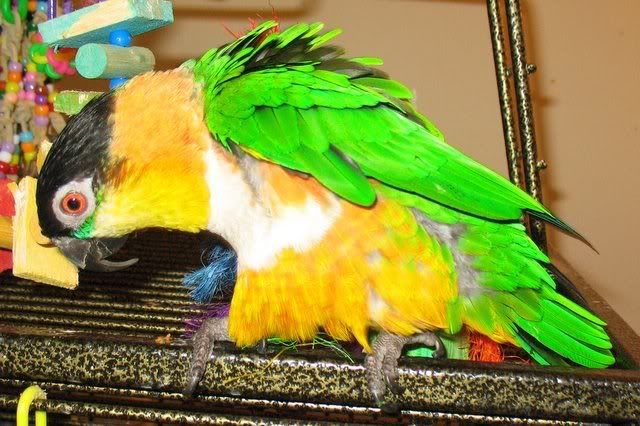
I have been giving this issue a lot of thought, and haven't come to an acceptable solution -- I'm not sure there is one. I'm hoping to flesh out my thoughts here and would love to hear if anyone reading this has anything additional to add. I'm going to call the bird "Frosty." That's not his name, but I want to provide my friend anonymity due to the subject matter. Also, due to space constraints (I'm really trying not to write a book!) I'm leaving out details of things that were tried to improve the situation. Believe me, they tried everything I can think of.
Frosty was in his early teens when he was surrendered to her two years ago. He had suffered terrible abuse and neglect in his early life. He's extremely human-aggressive AND bird-aggressive. Despite great precautions, he severely bit at least three volunteers. He also escaped from his cage one night and bit the beak off of one bird at the rescue and the toes of a couple of others (all of whom were in their cages, clinging to the side, trying to fight off this interloper).
My friend found a foster home for Frosty with a woman who had a lot of experience with difficult cockatoos. She was completely upfront with this woman about Frosty and his challenges. The hope was that the combination of positive interactions with this experienced cockatoo owner and living in a flock of cockatoos would help turn Frosty around. It didn't work.
After Frosty initiated several unprovoked attacks on other members of the flock (luckily, none of them suffered permanent damage), the decision was made that Frosty needed to be caged when other birds were around and could only be let out when the others were caged. It was a difficult balance, as her other cockatoos had to get used to spending more time in their cages than before.
His attacks on his human foster mom continued. She could find no discernible reason for the attacks. Unfortunately, Frosty's favorite attack target was the face, and this woman had to go to the emergency room for stitches in her face at least five times, including twice in one week. If anything, during the time he spent in foster care, he got worse.
Life intervened, and his foster mom had to move across the country. She took her permanent flock with her, but made the decision that she couldn't take Frosty. And I can't say that I blame her, as her other cockatoos were starting to show signs of stress with Frosty in the home.
Frosty is now back at my friend's rescue, and she doesn't know what to do. Possibly he would be OK in an only-bird home where the owner was constantly vigilant; however, finding a home where someone would have the experience to deal with this kind of behavior problem and they don't already own birds? Nearly impossible.
After long discussions with her vet, the decision was made to neuter Frosty. I believe this surgery is scheduled for sometime in February. Although it's a risky procedure and we don't know whether this will solve the problem, it gives her hope. Me? I'm a bit more pessimistic about things. He wasn't aggressive only during hormonal periods -- this is a daily thing. Although I'm certainly no expert, it seems to be as though he's mentally insane. I've read reports where people have become mentally unhinged after suffering severe abuse; I would think that a similar thing could happen to a parrot.
My friend firmly believes in the no-kill philosophy, and that's part of the reason she's struggling so much with Frosty. Can he possibly be happy? Would it be kinder to put him out of his misery? What options are there for him? Since he is aggressive to humans and parrots, it would seem as though his life would be relegated to living alone in a cage. Is it fair to do that to a majestic wild animal, who has already suffered so much, for possibly another 60 years or more? A dog who had sent a person to the emergency room five times would already have been euthanized. Should parrots be held to a similar standard?
I'm leaning towards euthanasia in this case. All over my blog, I've talked about the amazing resiliency of parrots and how they can overcome horrible pasts to find happiness again. I still believe that to be the case. However, I believe that there are some extreme cases where it is kinder to the bird to end his suffering. He doesn't appear to be physically suffering, but his mental anguish, in order for his behavior to be so aggressive, must be extreme.
I'm not sure my friend is willing to go that route. She's really hoping that the neutering will do the trick; if it doesn't, she's desperate to find another solution. I'll keep you updated on what happens.
Finally, in my experience (which does not include living with any of them), cockatoos seem to be the parrots who are the least resilient; the least able to cope with life in captivity. If you are considering adding one to your home, please visit this site. (Note that loud cockatoo noises start a few seconds after going to this site, so beware if you're at work or need to be quiet). The second page, in which there is no noise, can be found here. If you'd like to interact with people living with cockatoos, here is the forum. It's not a fluff board -- they tell it like it is.