I've had just about enough (or, quite accurately, more than enough) sad parrot news this week. So instead I will write a bit about a parrot success in Costa Rica. I intended to write about this last month when I got the May 2011 issue of PsittaScene -- the magazine members in the World Parrot Trust receive, but then life (and work) intervened.
When I looked at the cover -- wild scarlet macaws! It reminded me of our trip to Costa Rica in 2009. Imagine my surprise when I turn to the article: not only was it about scarlet macaw releases at the place we stayed (Tiskita Jungle Lodge -- highly recommended!), but it was written by the biologist who spent several days with us. She was an incredibly nice and knowledgeable person. She talked for hours with us about the macaws that had been released. It just so happened that we were there the week in May 2009 when scarlet macaws were being released, which was very exciting (though for security reasons, in case we were poachers, we were not allowed to know where the release site was.)
She had a photo album with pictures of all of the wild scarlet macaws in the area and she knew each of the approximately 50 individuals by name -- she could tell them apart at a glance. When we showed her pictures of the macaws we saw, she identified them and told us their stories -- the male was Dylan and the female was Red. Apparently there has been a shake-up, as the article mentions that Red is now with Big Boy -- there was no mention of Dylan. (You can see pictures of them here, which is the same as the second link above.)
She often joked that the lives of the scarlet macaws could be on a soap opera, and she regaled us with stories. We asked her to start a blog, and she said she'd been thinking of it. I'm not sure who's writing it, but there is one that has some stories of the wild scarlets now!
What an amazing trip we had; I would recommend a trip to Tiskita for anyone who is looking for a relaxing wildlife vacation. We can't wait to go back!
Showing posts with label wild parrots. Show all posts
Showing posts with label wild parrots. Show all posts
Friday, August 5, 2011

Monday, March 14, 2011
Amsterdam birding
Before going to Amsterdam, we'd contacted Flevo Birdwatching to take us on a tour. They'd know the spots to go and be able to help us with identification of European birds. We were a few weeks too early for the migrants, who were mostly still in Africa, but we did get to see quite a few waterbirds and we were able to add quite a few new species.
Walking around town, we also caught sight of different birds, especially the Eurasian Coot, which was practically ubiquitous on the canals, defending its territory: ETA: Here is a description with pictures of the differences. I can't really tell what the differences are, but they do have different latin names (Fulica americana vs. Fulica atra). The European coots seemed more aggressive than the American ones I've seen, but that could just be due to the fact that these guys are city coots and the American ones I've seen were country coots. Maybe that hardens them? :)
A few moorhens in the park: Here are a couple of Egyptian Geese walking in front of the IAmsterdam sign (the IAm was curiously missing):
 While lunching with our birding guide, this tit flew on to our picnic table and attempted to get some food from us:
 Just some of the ducks on the pond:
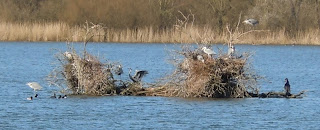
 It was so beautiful! The cormorants were nesting:
 And there were a bunch of grey herons in the same pond:
 A pigeon and a couple of gulls near the Rijksmuseum:
 Though we didn't get any decent pictures, we saw ringneck parakeets at several different locations throughout the city. At first we thought they were quakers, until we got a better look.
It's so great to be back, though we did have a great time. Spring is approaching and our current birding adventures will be much closer to home!
Walking around town, we also caught sight of different birds, especially the Eurasian Coot, which was practically ubiquitous on the canals, defending its territory:
 ETA: Here is a description with pictures of the differences. I can't really tell what the differences are, but they do have different latin names (Fulica americana vs. Fulica atra). The European coots seemed more aggressive than the American ones I've seen, but that could just be due to the fact that these guys are city coots and the American ones I've seen were country coots. Maybe that hardens them? :)
A few moorhens in the park:
 Here are a couple of Egyptian Geese walking in front of the IAmsterdam sign (the IAm was curiously missing):
 While lunching with our birding guide, this tit flew on to our picnic table and attempted to get some food from us:
 Just some of the ducks on the pond:
 It was so beautiful! The cormorants were nesting:
 And there were a bunch of grey herons in the same pond:
 A pigeon and a couple of gulls near the Rijksmuseum:
 Though we didn't get any decent pictures, we saw ringneck parakeets at several different locations throughout the city. At first we thought they were quakers, until we got a better look.
It's so great to be back, though we did have a great time. Spring is approaching and our current birding adventures will be much closer to home!
Friday, June 4, 2010
Drunk parrots
I just saw this article, which talks about some wild lorikeets that appear to be getting drunk.
I know I shouldn't laugh, but parts of the article were quite funny. For example, this quote:
Poor guys, though I can totally see parrots figuring out a way to get a buzz and then overindulging a bit...
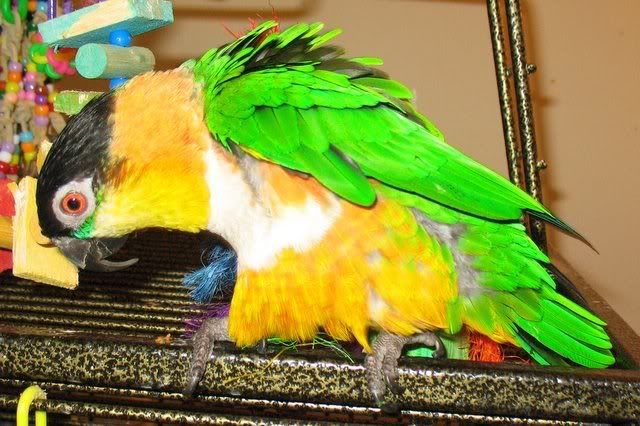
Our caique Beeps must have been given alcohol in a previous home. Whenever one of us is drinking a beer or some wine, he flies over and tries to help himself. It can be a challenge to keep him out of our glasses!
I know I shouldn't laugh, but parts of the article were quite funny. For example, this quote:
"They fall out of trees... and they're not so coordinated as they would normally be. They go to jump and they miss the next perch."
Poor guys, though I can totally see parrots figuring out a way to get a buzz and then overindulging a bit...
Our caique Beeps must have been given alcohol in a previous home. Whenever one of us is drinking a beer or some wine, he flies over and tries to help himself. It can be a challenge to keep him out of our glasses!
Monday, October 26, 2009
Cat City
I'm back blogging after a week's vacation in Istanbul, Turkey. What a wonderful trip we had! I would highly recommend this destination. I'll post more on our trip in the upcoming weeks, but I wanted to post some of my cat pictures. More will follow!
I have never seen so many stray cats in my life. When we were outside, I don't think I went more than 5 minutes without seeing one! If I'd taken pictures of every one I'd seen, that's all I would have had time to do.
This cat was lounging in the grounds of Mosque of Suleyman the Magnificent. When I stopped petting her, she meowed and looked forlornly after me. Not all of the cats were this welcoming to human attention!

Cats lounging in the shadow of Chora Church: Cats in Asian Turkey:
 We didn't get the greatest picture, but were unsure what this cat had done to earn the medal around his neck:
 Earlier in the week, we had seen a beautiful all-white cat limping towards us. She looked at us, and we were startled to see that she had one green eye and one blue eye. She was so stunning that she'd run away before I gathered my wits about me to take a picture! Back in my hotel room, I read in the guidebook that she was most likely an endangered Van Cat.
We didn't see another one, but after that, every white cat we saw, we endeavored to take its picture! In addition to cats, we saw several ringneck parakeets flying around in the Hagia Sophia and Topkapi Palace areas. We heard them before we saw them, but did have the pleasure several times to see them soaring high above us; their brilliant green feathers shining against the blue sky. We assume these are escapees -- we'd also seen ringneck parakeets at Kew Gardens in London.
I have never seen so many stray cats in my life. When we were outside, I don't think I went more than 5 minutes without seeing one! If I'd taken pictures of every one I'd seen, that's all I would have had time to do.
This cat was lounging in the grounds of Mosque of Suleyman the Magnificent. When I stopped petting her, she meowed and looked forlornly after me. Not all of the cats were this welcoming to human attention!

Cats lounging in the shadow of Chora Church:
 Cats in Asian Turkey:
 We didn't get the greatest picture, but were unsure what this cat had done to earn the medal around his neck:
 Earlier in the week, we had seen a beautiful all-white cat limping towards us. She looked at us, and we were startled to see that she had one green eye and one blue eye. She was so stunning that she'd run away before I gathered my wits about me to take a picture! Back in my hotel room, I read in the guidebook that she was most likely an endangered Van Cat.
We didn't see another one, but after that, every white cat we saw, we endeavored to take its picture!
 In addition to cats, we saw several ringneck parakeets flying around in the Hagia Sophia and Topkapi Palace areas. We heard them before we saw them, but did have the pleasure several times to see them soaring high above us; their brilliant green feathers shining against the blue sky. We assume these are escapees -- we'd also seen ringneck parakeets at Kew Gardens in London.
Wednesday, May 20, 2009
Costa Rican wildlife
Thomas and I returned earlier this week from a week's vacation in Costa Rica. The main purpose of our trip was to stay at the amazing Tiskita Jungle Lodge while getting to see wild scarlet macaws flying free.
We had an amazing, incredible time, and I can't say enough good things about our experience at Tiskita. I'd highly recommend this place to anyone who loves seeing wildlife, and Thomas and I will definitely be going back in the future. If anyone interested in going there has any questions, just leave a comment and I will do my best to answer!
Just ten years ago, there were no wild macaws flying around in the jungles around Tiskita. Their habitat had been lost due to slash-and-burning. The owners of the lodge (Peter and Lizbeth) purchased a large chunk of desolate land and got to work returning it to its splendor, ultimately achieving what is a wildlife paradise. They have a huge fruit orchard, and plant trees with the goal of pleasing the current wildlife inhabitants and perhaps attracting even more (like spider monkeys, who do not yet appear to live there).
I could go on and on, but instead will show some pictures!
It's kind of hard to see this guy, but here is a sloth:
 There is a specific kind of tree that sloths like, and Peter planted several around the lodge for that reason.
The lodge is right on the ocean -- how calming to fall asleep to the sound of the waves at night! Here are a couple of pelicans we saw resting on a rock:
 I'm not sure what kind of lizard this is (there were many different kinds of lizards!) but I liked his pose:
 This iguana, resting in the grass, was the first animal we saw upon arrival:
 Later, we saw another hanging out on a rock:
 This green iguana spent most of his time basking on a leaf right outside of our cabin -- this picture was taken while on our porch:
 Peter and Lizbeth hope that eventually every cabin will have its own ghost bat living near it; our cabin didn't have one yet, but we found one at another one:
 The beautiful scarlet macaw; the main purpose for our trip:
 We spent the first few days seeing them fly overhead and hearing their squawks, but we didn't come close enough to take any decent pictures. The biologist told us that they're very good at hiding and that our best chance of seeing a pair would be to catch them foraging. We'd most likely see the mess they were making before we saw them. And that's exactly what happened! We would have walked right by the tree in which they were perching had they not discarded so much food waste!
We spent a little over an hour watching them forage in this beach almond tree. They spent most of their time in the same tree, but they weren't particularly close to one another. After about 50 minutes, the male came over by the female, squawked, and then took off, landing in a neighboring tree. The female apparently was still hungry, and she stayed and foraged in her original position. The male then started foraging in his new tree. We watched this for another 30 minutes or so until we left. About 10 minutes later, we heard a squawk and saw them flying away together.
It's really amazing how completely these giant red birds can be camouflaged! The biologists are able to tell all 50 or so macaws apart based on feathering and coloring on their wings. The male of the couple we were watching was named Dylan and the female was Red.
The first macaws were set free about 6 or 7 years ago. Last year was the first year that macaws successfully nested in the wild -- there are now 3 one-year-old macaws hatched in this forest and flying free! And several pair right now are nesting but the babies have not yet fledged -- the biologists are keeping a close eye on them. This was so exciting as it was proof that the flock is being established and therefore has a better chance at long-term survival.
The agouti is a rodent-like animal that we saw quite frequently. There was one that was foraging on the trail we took down to breakfast every morning. As long as we didn't approach her, she wasn't bothered by our presence: Since it's spring, we saw a few babies from different species; here is a young agouti:
 I'm not sure what birds these are, but I liked the picture, so I'm posting it!
 Peter found a boa constrictor near the lodge; he called us over as he used a tool to safely grab him up and then place him safely in a tree:
 Kind of hard to spot -- no wonder we didn't see any while out walking in the jungle!
We went on a hike with Lizbeth, where she showed us some of her favorite parts of the forest. She knows where certain birds like to hang out, and because of her we saw three different kinds of manakins and several woodpeckers, along with others. No pictures, though -- they were too quick for us!
Towards the end of our walk, she saw movement out of the corner of her eye -- we had happened upon a group of white-faced monkeys! They were eating fruit in the orchard. We sat there for about an hour and watched them. It was so fascinating! We could see a few babies clinging to their mothers as they swung from tree to tree.
This little guy is eating a piece of fruit; he proceeded to lick his fingers afterwards; it was so adorable!
 In this video, you can see one of the juvenile males trying to scare us off. Two different monkeys tried to scare us off, but after we remained still where we were, they appeared to forget about us. (We stayed a decent distance from them -- the owners do not want the wildlife becoming tame at all as that can be dangerous to them).
The last day, we took one last walk down to the pond in order to hopefully spot the resident crocodile who had eluded us the rest of the week. On the way down, we heard a very distinctive bird call coming from this bird of prey: And then, success! As though he knew we were leaving yet wanted a glimpse of him, the crocodile appeared:
 In addition to the animals pictured and mentioned, we also saw coati, a tayra (apparently quite rare to see!), land crabs, howler monkeys, squirrel monkeys, and many other lizards, hummingbirds, birds, butterflies, frogs, toads, etc. Our experience was absolutely amazing; and I can't thank Peter and Lizbeth enough for such a magical vacation. I can't wait to go back!
We had an amazing, incredible time, and I can't say enough good things about our experience at Tiskita. I'd highly recommend this place to anyone who loves seeing wildlife, and Thomas and I will definitely be going back in the future. If anyone interested in going there has any questions, just leave a comment and I will do my best to answer!
Just ten years ago, there were no wild macaws flying around in the jungles around Tiskita. Their habitat had been lost due to slash-and-burning. The owners of the lodge (Peter and Lizbeth) purchased a large chunk of desolate land and got to work returning it to its splendor, ultimately achieving what is a wildlife paradise. They have a huge fruit orchard, and plant trees with the goal of pleasing the current wildlife inhabitants and perhaps attracting even more (like spider monkeys, who do not yet appear to live there).
I could go on and on, but instead will show some pictures!
It's kind of hard to see this guy, but here is a sloth:
 There is a specific kind of tree that sloths like, and Peter planted several around the lodge for that reason.
The lodge is right on the ocean -- how calming to fall asleep to the sound of the waves at night! Here are a couple of pelicans we saw resting on a rock:
 I'm not sure what kind of lizard this is (there were many different kinds of lizards!) but I liked his pose:
 This iguana, resting in the grass, was the first animal we saw upon arrival:
 Later, we saw another hanging out on a rock:
 This green iguana spent most of his time basking on a leaf right outside of our cabin -- this picture was taken while on our porch:
 Peter and Lizbeth hope that eventually every cabin will have its own ghost bat living near it; our cabin didn't have one yet, but we found one at another one:
 The beautiful scarlet macaw; the main purpose for our trip:
 We spent the first few days seeing them fly overhead and hearing their squawks, but we didn't come close enough to take any decent pictures. The biologist told us that they're very good at hiding and that our best chance of seeing a pair would be to catch them foraging. We'd most likely see the mess they were making before we saw them. And that's exactly what happened! We would have walked right by the tree in which they were perching had they not discarded so much food waste!
We spent a little over an hour watching them forage in this beach almond tree. They spent most of their time in the same tree, but they weren't particularly close to one another. After about 50 minutes, the male came over by the female, squawked, and then took off, landing in a neighboring tree. The female apparently was still hungry, and she stayed and foraged in her original position. The male then started foraging in his new tree. We watched this for another 30 minutes or so until we left. About 10 minutes later, we heard a squawk and saw them flying away together.
It's really amazing how completely these giant red birds can be camouflaged!
 The biologists are able to tell all 50 or so macaws apart based on feathering and coloring on their wings. The male of the couple we were watching was named Dylan and the female was Red.
The first macaws were set free about 6 or 7 years ago. Last year was the first year that macaws successfully nested in the wild -- there are now 3 one-year-old macaws hatched in this forest and flying free! And several pair right now are nesting but the babies have not yet fledged -- the biologists are keeping a close eye on them. This was so exciting as it was proof that the flock is being established and therefore has a better chance at long-term survival.
The agouti is a rodent-like animal that we saw quite frequently. There was one that was foraging on the trail we took down to breakfast every morning. As long as we didn't approach her, she wasn't bothered by our presence:
 Since it's spring, we saw a few babies from different species; here is a young agouti:
 I'm not sure what birds these are, but I liked the picture, so I'm posting it!
 Peter found a boa constrictor near the lodge; he called us over as he used a tool to safely grab him up and then place him safely in a tree:
 Kind of hard to spot -- no wonder we didn't see any while out walking in the jungle!
We went on a hike with Lizbeth, where she showed us some of her favorite parts of the forest. She knows where certain birds like to hang out, and because of her we saw three different kinds of manakins and several woodpeckers, along with others. No pictures, though -- they were too quick for us!
Towards the end of our walk, she saw movement out of the corner of her eye -- we had happened upon a group of white-faced monkeys! They were eating fruit in the orchard. We sat there for about an hour and watched them. It was so fascinating! We could see a few babies clinging to their mothers as they swung from tree to tree.
This little guy is eating a piece of fruit; he proceeded to lick his fingers afterwards; it was so adorable!
 In this video, you can see one of the juvenile males trying to scare us off. Two different monkeys tried to scare us off, but after we remained still where we were, they appeared to forget about us. (We stayed a decent distance from them -- the owners do not want the wildlife becoming tame at all as that can be dangerous to them).
The last day, we took one last walk down to the pond in order to hopefully spot the resident crocodile who had eluded us the rest of the week. On the way down, we heard a very distinctive bird call coming from this bird of prey:
 And then, success! As though he knew we were leaving yet wanted a glimpse of him, the crocodile appeared:
 In addition to the animals pictured and mentioned, we also saw coati, a tayra (apparently quite rare to see!), land crabs, howler monkeys, squirrel monkeys, and many other lizards, hummingbirds, birds, butterflies, frogs, toads, etc. Our experience was absolutely amazing; and I can't thank Peter and Lizbeth enough for such a magical vacation. I can't wait to go back!
Monday, May 18, 2009
Macaws in flight
Our second day in Costa Rica brought us our first glimpses of wild scarlet macaws. We'd heard them previously; their loud squawks penetrating the jungle. Every time we saw them, we actually heard them first. Sadly, they are backlit so their beautiful colors are hidden in these pictures.


 That's all I have time for today -- more pictures to follow!


 That's all I have time for today -- more pictures to follow!
Subscribe to:
Posts (Atom)