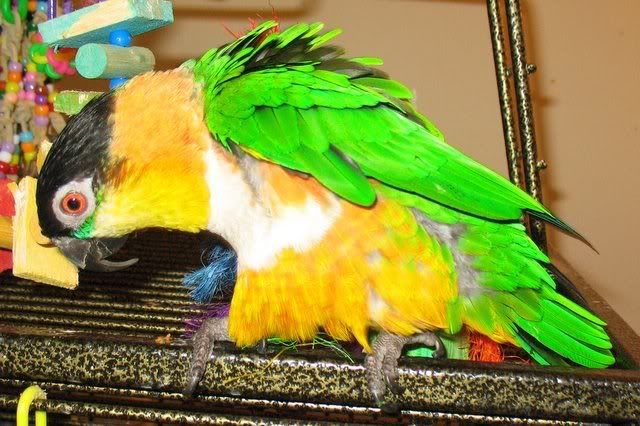
I received this question in the comments, which I will answer below:
I found your blog while looking for approaches to handling my hormonal caique. Do you know of any dietary options by chance?
The bird's hatch date is 12/19/09, and this year she's been on an extended celebration. I've had her since May '10 or so. "Her" isn't formally confirmed; breeder's guess by feeling the pelvic bones.
Her diet is a variety of fruit/veggies in the morning and access to a grain mix during the day.
Other than a recent plumbing disaster (variety of chemicals used, cutting a drain pipe, etc.), and a family visit during the holidays, no changes to our normal routine. It's been several days of return to normalcy, but aggressive behavior has intensified.
The bird is normally cage-free, with a bull terrier in the house (equally cage-free). Lately, they've been going at each other, with the bird instigating. The bird isn't clipped, and the dog is sufficiently well-behaved, so it hasn't been a concern in the past; however, the bird hasn't been provoking the dog to this degree before. Typically, it's the other way around.
With me, behavior is a roller-coaster. I can tolerate occasional beaking, but a love-bite on the lip from a reach-around lunge off my shoulder that I can't see coming is a bit much.
I grab her following incidents (to prevent further damage - to me) and deposit her in the cage, leaving the room. She then is pretty insistent on calling me back. When I come back, I can see the typical signs of an aggressive posture. If I open the cage and tell her to step up, she will and very shortly attempt to attack.
Any suggestions appreciated.
Hello, and welcome to the world of mature caiques. As always, I must disclaim that every bird is an individual, but over my years of parrot ownership and volunteering at the rescue, I have done as much research as I could to try to give my parrots the best captive life I could, so I feel comfortable making generalizations, which I will do here, though of course it does not apply to every individual of the species.
There used to be a good site about caiques that appears to no longer be available online. I remember very vividly the line "biting is one of the downsides of caique ownership." I've found that to be true, to a point. The site also mentioned that they tend not to do well with other animals in the house, but I'll get into that more down below.
One of the great things about caiques is that typically they are very expressive, so once you get to know their body language, you can usually avoid bites by not trying to handle them when they are agitated.
I have two teenage male caiques, Calypso (18; I've had him 9 years) and Beeps (14; I've had him 6 years.) Calypso has never bitten me, though he had bitten my ex-husband in the past. He also postures as though he will bite me occasionally when I ask him to step up. Instead of forcing him, I leave him be and try again later. He is also trained to step up on a stick in case I absolutely needed to move him. I believe Calypso is quite an anomaly among caiques with regards to biting, and I feel very lucky!
Beeps, on the other hand, gets worked up quite a bit. He is very difficult to handle for a few months every year -- typically this has been December - February -- and then his sweet personality returns for the spring, summer, and fall. He also has triggers; things that will set him off. For example, the container in which I keep my lizard's food incites Beeps to launch flying attacks at me, so I always make sure Beeps is locked in his cage before I feed Andreas.
What you've described sounds like it may be hormonal biting.
You can certainly try experimenting with different foods. If you do that, I'd recommend keeping a journal so you can see if there are any correlations between what she eats and her behavior. I tried with Beeps in the past, but never noticed any difference. Some people recommend using cooled chamomile tea in place of water to help calm an agitated bird down. Once again, this never made any difference for me.
The first thing I recommend is to make sure to keep the caique and the dog separate. Sadly, I have known dozens of birds killed by the family pet (I come into contact with a lot of people at the parrot rescue.) Every time, the story starts out "they always got along..." and usually involves "the bird always flew out of reach before" and "the dog/cat is so well-natured. I can't believe it!" I feel the risk is just far too great. When instincts are involved, it only takes a second, and even careful supervision can't stop a tragedy from happening (I lost a dear budgie in 2011 to another animal when I was carefully supervising. I wasn't fast enough and instead had a front-row seat to the tragedy. I so wish I would have enforced true separation that would have saved his life.)
Additionally, it sounds like perhaps your caique has chosen you as her mate, and so she feels the need to drive her competition (the dog) out of the way, so separation may help calm down the hormones.
You mention that she is normally cage-free. Does she have a cage where she sleeps and spends some time? Birds really do best with routine and some limits. Cages are not punishments. My birds love their cages and will frequently go inside them during the day. Perhaps she needs to get started on a routine that involves cage time. Mine do best with 12 hours of uninterrupted sleep a night, and I see a definite difference in behavior. How much sleep is she getting? (Dark, uninterrupted; not with someone watching TV in the same room.)
What you do when she bites may actually be reinforcing to her, as she gets attention immediately when you pick her up. It's likely she does not realize that her behavior caused her to be put in her cage, since it's too far removed, and she was already rewarded by your attention. Then, she calls to you, as a lone bird in the wild is most likely a dead bird. They are flock animals and only a few generations removed from the wild, so with all of the instincts that serve them well in the jungle but not as well in our living rooms.
What you want to try to do is learn her body language and prevent bites. With Calypso, if I offer him my hand, he'll either step up nicely or he'll make a squealing fuss. If it's the latter, he's probably going to bite. So I either leave him alone until he's calmed down and try again, or, if I need to move him somewhere, I'll use a stick.
With Beeps, things are a bit more interesting. As background, both caiques are unclipped, but only Beeps really flies. I noticed that right before he'd bite, his eyes would start to flash. I watched him carefully, and as soon as I saw his eyes flash, I'd point to his cage and tell him to go inside. He'd fly there from wherever he was, go inside, I'd shut the cage door, and then he'd have his meltdown. After a few months of this, he started to go inside his cage on his own when he felt a meltdown happening. I need to pay attention and shut him inside until he calms down, otherwise he may come out of his cage and launch an attack. He's also stick-trained, should I need him to go somewhere he doesn't want to fly to.
I truly believe that they want to behave, but sometimes they can't control their behavior!
Another thing that may help is exercise. You can develop games to have her flying around. In the wild, they'd be flying and exercising their excess energy away. Here, they just don't do that, so it often manifests itself in undesirable behaviors, like attacking. Get her panting. This could be having her on your hand when you go up and down (this is what I do with Beeps), or assisted flying (this is Calypso's favorite. I cup my hands under his chest and we "fly" around my apartment, with me running.) Since she flies, you can put her on her stand and call her to you (this is how I exercise my grey.) There are a million ways (maybe not quite that many!) that you can exercise her, so find a way that is fun for both of you!
I'd also recommend keeping her brain stimulated. In my house, we do trick training using a clicker. They love it, and it's a positive way for them to expend some mental energy.
It sounds like you allow her on your shoulder, based on one of your comments. I know that many, if not most, parrot owners encourage this. However, I do not at all. If I were queen of captive parrots, this is something that no one would do! And especially not with a parrot who has ever shown hormonal tendencies or has ever bitten anyone (so, pretty much all parrots.) Possibly excepting budgies and tiels.
Here's why: you can't see their body language, so it's very easy to all of a sudden get a face bite "out of nowhere" when the bird had been giving warnings that could have prevented it.
I have personally witnessed a macaw bite a chunk of cartilage out of someone's ear. He was on his favorite person's shoulder and gave him a warning. In the wild, he'd get a beak full of feathers and his communication would have been proper. In captivity, he can do major damage and might lose his home. I have also seen and known many people who have had to get stitches for a facial bite. The risk is just far too high, and usually it's the bird that ends up losing. Once again, far better to prevent than to react.
As I am rambling on, as usual, here is a quick summary, with a few extras:
1. Keep bird and dog separate at all times.
2. 12 hours of dark, uninterrupted sleep every night.
3. Watch body language closely and prevent (rather than react to) bites.
4. Develop another way to handle her when she's agitated (e.g. stick train.)
5. Exercise until she's panting, several times a day.
6. Keep her brain stimulated (e.g. trick training.)
7. Absolutely no shoulders.
8. Keep all petting (if any) to the head only. Absolutely no petting below the neck, under the wings, etc. You are turning her on and making promises you can't keep. No playing on/under blankets. No nest boxes or anything that might approximate one.
9. Do not feed warm, mushy foods.
Good luck! I do hope this calms down soon, but you may need to realize that you will have a few months every year with limited physical interaction with her. This is the case for Beeps and me, but once his hormonal season has ended, our relationship returns to what it was before the hormones kicked in. Other people may chime in with additional thoughts, and I will add anything here if I think of something else to say!