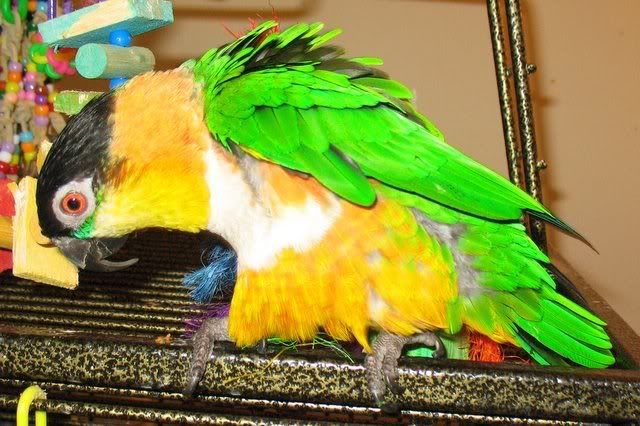
I had made a much better video of this, but apparently I hadn't pressed "record." Argh! As Thomas was drinking this morning, Brian kept trying to fly into his glass, a clear signal Brian wanted to take a bath!
Right before this, in the video I didn't actually take, he'd jumped all the way inside and splashed around a bit before exiting again.
A still shot, mid-bath:
After; my wet budgie:
We've tried other bathing methods, but this is what he prefers. I have no idea why -- since he'd never been let out of his cage at his previous home, it's not like this is what he was used to.
Thursday, October 13, 2011
Tuesday, October 11, 2011
Calypso forages
Being in the kitchen means Calypso is getting on the blog more frequently! This morning, I looked over and he was standing on his foraging bucket, throwing out his foot toys and toy parts. After he was done, I put everything back in and I'm sure he'll empty it again soon.
Monday, October 10, 2011
Kitchen birds
Calypso may have permanently become a kitchen bird. We moved him in a month or so ago because his hormones were out of control. We thought perhaps a change of scenery and removal from the presence of Beeps and Basil (the two parrots he'd try to attack) would do him some good -- and it did!
We tried bringing him back in the living room over the weekend. Within minutes, he tried to attack Beeps; thwarted, he turned his attention to Basil (thwarted again.) Needless to say, he immediately went back into the kitchen!
I think he likes getting more one-on-one attention in the kitchen, especially in the morning before we get the other birds up. He's even starting to bond with Thomas a bit more, which has been great to see. This could have something to do with receiving a near-daily piece of toast from him:
Brian continues to get his toast in the following way:
He mostly just rips tiny pieces of toast off (you can see the crumbs on the plate under his beak) rather than eat much. It's a giant toast toy.
In other Brian news, he talks a lot when he's on my shoulder, but much of it is unintelligible budgie chatter. So, it may go like this: "chatter chatter chatter gotta go chatter chatter shot and a beer chatter." Or, "chatter get me a beer *whistle whistle whistle* chatter chatter do ya wanna." With me understanding less than half of the words he says (and with much of what he says tantalizingly incomplete -- where do you gotta go? Do I wanna what?) This weekend, for the first time, included in that chatter, he said his name, but with a bit of an impediment -- he said "Bwian." Can he get any cuter? (I am trying to get this on video, but he really only talks when he's on our shoulders, and when he sees the camera, he quiets down and gazes into the lens.) Maybe someday I will be successful!
We tried bringing him back in the living room over the weekend. Within minutes, he tried to attack Beeps; thwarted, he turned his attention to Basil (thwarted again.) Needless to say, he immediately went back into the kitchen!
I think he likes getting more one-on-one attention in the kitchen, especially in the morning before we get the other birds up. He's even starting to bond with Thomas a bit more, which has been great to see. This could have something to do with receiving a near-daily piece of toast from him:
Brian continues to get his toast in the following way:
He mostly just rips tiny pieces of toast off (you can see the crumbs on the plate under his beak) rather than eat much. It's a giant toast toy.
In other Brian news, he talks a lot when he's on my shoulder, but much of it is unintelligible budgie chatter. So, it may go like this: "chatter chatter chatter gotta go chatter chatter shot and a beer chatter." Or, "chatter get me a beer *whistle whistle whistle* chatter chatter do ya wanna." With me understanding less than half of the words he says (and with much of what he says tantalizingly incomplete -- where do you gotta go? Do I wanna what?) This weekend, for the first time, included in that chatter, he said his name, but with a bit of an impediment -- he said "Bwian." Can he get any cuter? (I am trying to get this on video, but he really only talks when he's on our shoulders, and when he sees the camera, he quiets down and gazes into the lens.) Maybe someday I will be successful!
A bit of Rocky
Rocky, who screams when he's locked inside his own cage, again willingly went into someone else's cage to play with toys:
He then came out and started throwing all of the foot toys and toy parts out of Calypso's foraging bucket:
He's gone back to doing one of my favorite things: hanging out underneath his cage. This is nesting behavior. This year, in a twist, he knocked a phone book off of the top of his cage and dragged it under so he can shred it.
Last night, Thomas was trying to get Rocky to come out as it was time to go to bed, but Rocky stayed under the cage, singing and talking. We think he was trying to entice Thomas into his nest, but as it's barely big enough for a severe macaw to enter, a human certainly wouldn't fit.
Thomas was prone on the floor, asking Rocky to come out. Of course, when I came over to take a picture, Rocky emerged to threaten me:
After he was in his cage, we had more sweeping to do.
He then came out and started throwing all of the foot toys and toy parts out of Calypso's foraging bucket:
He's gone back to doing one of my favorite things: hanging out underneath his cage. This is nesting behavior. This year, in a twist, he knocked a phone book off of the top of his cage and dragged it under so he can shred it.
Last night, Thomas was trying to get Rocky to come out as it was time to go to bed, but Rocky stayed under the cage, singing and talking. We think he was trying to entice Thomas into his nest, but as it's barely big enough for a severe macaw to enter, a human certainly wouldn't fit.
Thomas was prone on the floor, asking Rocky to come out. Of course, when I came over to take a picture, Rocky emerged to threaten me:
After he was in his cage, we had more sweeping to do.
Friday, October 7, 2011
Foraging for air
Last weekend I'd found an old foraging tower that Max used to use many years ago. I don't think I've even had it out in the 3+ years Stella's been with us. It was on the table, and there was a cashew in it, which (with my help), Max managed to dispense this morning.
Then, even though I hadn't replaced the cashew, which Max should have known since the toy is see-through, she started playing with the levers, hoping a nut might materialize. Of course this brought Stella over, and for quite some time, both of them were banging on different sides of the tower.
I didn't get a good picture of both of them working on it at the same time, but it was funny to watch. I don't think Stella had any idea why she was doing that, but I suspect Max was hoping for a cashew.
Maybe this weekend I'll put another nut in and see if they can figure it out.
Then, even though I hadn't replaced the cashew, which Max should have known since the toy is see-through, she started playing with the levers, hoping a nut might materialize. Of course this brought Stella over, and for quite some time, both of them were banging on different sides of the tower.
I didn't get a good picture of both of them working on it at the same time, but it was funny to watch. I don't think Stella had any idea why she was doing that, but I suspect Max was hoping for a cashew.
Maybe this weekend I'll put another nut in and see if they can figure it out.
Some recent questions
I had a few questions in the recent comments that I thought I might just address here instead of in the comments since it took me some time to finally get around to them!
Of course I can't answer this for all greys since every parrot is an individual, but I do think that greys have the tendency to be very curious and intelligent and therefore get into everything, including trouble! I must also add that when Max was a single grey, she did not get into nearly as much as she has since Stella arrived. Because they are flock animals, I believe that the presence of another grey motivates them to explore. I also believe that a big part of the reason why Stella transformed so quickly into a happy bird after her mutilation is the presence of Max -- even though they don't physically interact, I think that Max was a good role model for Stella.
Additionally, we encourage our parrots to explore and make their own choices as much as possible. That, combined with the fact that they can fly, may make them more likely to get into things than an average grey who is clipped and may only come out of his cage a few times a month. The fact that they frequently find food only reinforces this!
Officially, Basil is still just a foster bird. He is willed to us, so we were expecting to have him full-time at some point, though we thought it would be decades yet until this happened. Originally, he was just supposed to stay with us for a month or two, but it's not been nearly 10 months. His owners aren't ready yet to officially sign him over to us, though I suspect that will happen soon.
Luckily, he is quite possibly the lowest-maintenance parrot I have ever met. That's part of the reason I write about him so infrequently -- he's not doing many exciting things! He has integrated well into our house, has learned our routines, and I think he's pretty happy. I'd like to eventually get him playing with toys more frequently and stepping up nicely, but we have lots of time to work on that.
I do have a bit of guilt about keeping him, though if he is surrendered to us, he'll stay. He took the last open spot in our house, which I'd been planning on using to foster birds for the rescue and adopt them out, like with Steve. There's actually a (mutilating, seizure-prone so on meds twice a day, blind) grey at the rescue that I'd be fostering right now if it weren't for Basil. It doesn't sit well with me that such an easy, low-maintenance bird is taking the place of someone who needs us more, but that's the way things are.
I am not aware of any programs that return former pets to the wild, but frankly, I'd be very hesitant to go this route. While I do wish that all parrots could be wild and that we'd never brought them into our homes, I don't believe that those who've lived so long in captivity would possess the skills to survive and thrive in their native land. I've read a bit about the work done by the Ara Project in breeding macaws to release in the wild, and spoke with a biologist doing that work in Costa Rica. It's a lot of work to make sure that the bird is ready to live in the wild and won't just walk up to a human (to be recaptured) as that's what they know. I've also read about work done by captive breeding programs by the International Crane Foundation (for cranes, obviously!) and was involved in helping to raise orphan baby wildlife when I volunteered at a wildlife rescue center, and I know they try very strongly to make sure that the animals will not associate humans with food.
That being said, if you can't find any individuals who will take your birds when you're no longer around, I think the best thing to do is connect with a parrot rescue to make plans. This includes leaving money for them to be taken care of, possibly by means of an insurance policy. This should help ensure that the facility will be able to take your birds when it's time (many rescues are currently full with long waiting lists for surrenders and this problem will only get worse every year.) The good thing in your case is that your birds are smaller, so it should be easier to find someone to take them, even if it means they are split up. It's very difficult to find a good home for a cockatoo or macaw. I wish I had a better answer for you.
phonelady asked: do greys just naturally get into everything ? sure sounds like they do from your gang
Of course I can't answer this for all greys since every parrot is an individual, but I do think that greys have the tendency to be very curious and intelligent and therefore get into everything, including trouble! I must also add that when Max was a single grey, she did not get into nearly as much as she has since Stella arrived. Because they are flock animals, I believe that the presence of another grey motivates them to explore. I also believe that a big part of the reason why Stella transformed so quickly into a happy bird after her mutilation is the presence of Max -- even though they don't physically interact, I think that Max was a good role model for Stella.
Additionally, we encourage our parrots to explore and make their own choices as much as possible. That, combined with the fact that they can fly, may make them more likely to get into things than an average grey who is clipped and may only come out of his cage a few times a month. The fact that they frequently find food only reinforces this!
D. Richard asked: What if I may ask is the status of , Basil, Thought he would be home by now or do I not remember the proper dates ?
Officially, Basil is still just a foster bird. He is willed to us, so we were expecting to have him full-time at some point, though we thought it would be decades yet until this happened. Originally, he was just supposed to stay with us for a month or two, but it's not been nearly 10 months. His owners aren't ready yet to officially sign him over to us, though I suspect that will happen soon.
Luckily, he is quite possibly the lowest-maintenance parrot I have ever met. That's part of the reason I write about him so infrequently -- he's not doing many exciting things! He has integrated well into our house, has learned our routines, and I think he's pretty happy. I'd like to eventually get him playing with toys more frequently and stepping up nicely, but we have lots of time to work on that.
I do have a bit of guilt about keeping him, though if he is surrendered to us, he'll stay. He took the last open spot in our house, which I'd been planning on using to foster birds for the rescue and adopt them out, like with Steve. There's actually a (mutilating, seizure-prone so on meds twice a day, blind) grey at the rescue that I'd be fostering right now if it weren't for Basil. It doesn't sit well with me that such an easy, low-maintenance bird is taking the place of someone who needs us more, but that's the way things are.
D Richard continues: I am no spring chicken myself and I am a little worried about what to do with my flock in any event . I was wondering after you sent a review of RIO . what do you think of my leaving money to have my flock released in their respective lands at least for the conures and lovebirds . Australia does not want the cockatiels back and the same with the quaker, Both considered agricultural pests . But do you have any thoughts ? I don't have family or friends that would want them , Any of them
I am not aware of any programs that return former pets to the wild, but frankly, I'd be very hesitant to go this route. While I do wish that all parrots could be wild and that we'd never brought them into our homes, I don't believe that those who've lived so long in captivity would possess the skills to survive and thrive in their native land. I've read a bit about the work done by the Ara Project in breeding macaws to release in the wild, and spoke with a biologist doing that work in Costa Rica. It's a lot of work to make sure that the bird is ready to live in the wild and won't just walk up to a human (to be recaptured) as that's what they know. I've also read about work done by captive breeding programs by the International Crane Foundation (for cranes, obviously!) and was involved in helping to raise orphan baby wildlife when I volunteered at a wildlife rescue center, and I know they try very strongly to make sure that the animals will not associate humans with food.
That being said, if you can't find any individuals who will take your birds when you're no longer around, I think the best thing to do is connect with a parrot rescue to make plans. This includes leaving money for them to be taken care of, possibly by means of an insurance policy. This should help ensure that the facility will be able to take your birds when it's time (many rescues are currently full with long waiting lists for surrenders and this problem will only get worse every year.) The good thing in your case is that your birds are smaller, so it should be easier to find someone to take them, even if it means they are split up. It's very difficult to find a good home for a cockatoo or macaw. I wish I had a better answer for you.
Thursday, October 6, 2011
More neti pot fun
Stella is obsessed with Thomas and with the neti pot, so the combination of the two is irresistible for her. This was the scene this morning; yes, she is perching on his ear:
Tuesday, October 4, 2011
Pay attention to me!
Ran a marathon over the weekend, which meant that the afternoon was spent relaxing and eating. Thomas was in the living room watching football. I had been there as well, but then decided to go into the kitchen to listen to playoff baseball and catch up on the paper.
Of course, Max had to follow me in. I think she was a little miffed that I wasn't paying attention to her, as she started doing cute things to make me notice her:
Then, she flew to the table, found a receipt, and started shredding it:
She wasn't interested in this pecan when I'd offered it to her a few days earlier, but when she found it on Brian's cage, then it was interesting:
I brought Calypso from his cage (which is still in the kitchen) to the table so he could roam around. He decided to perch on my glass:
And then beg for me to pick him up:
So, not much roaming. Mostly trying to figure out how to get me to pick him up.
Rocky was torn -- stay behind with his preferred person, or keep an eye on his nemesis (me)? Several times, I caught him on the threshold of the hallway, trying to peek in on me. You'd think he just would have enjoyed some alone time with Thomas.
More paper shredding from Max:
The afternoon turned out not to be as relaxing as I'd hoped.
Of course, Max had to follow me in. I think she was a little miffed that I wasn't paying attention to her, as she started doing cute things to make me notice her:
Then, she flew to the table, found a receipt, and started shredding it:
She wasn't interested in this pecan when I'd offered it to her a few days earlier, but when she found it on Brian's cage, then it was interesting:
I brought Calypso from his cage (which is still in the kitchen) to the table so he could roam around. He decided to perch on my glass:
And then beg for me to pick him up:
So, not much roaming. Mostly trying to figure out how to get me to pick him up.
Rocky was torn -- stay behind with his preferred person, or keep an eye on his nemesis (me)? Several times, I caught him on the threshold of the hallway, trying to peek in on me. You'd think he just would have enjoyed some alone time with Thomas.
More paper shredding from Max:
The afternoon turned out not to be as relaxing as I'd hoped.
Monday, October 3, 2011
Grey doings
Yesterday, the greys were at it again. They just love to egg each other on. Max was on the counter, so Stella had to fly to the counter. Then, Max noticed one of Stella's favorite things -- the neti pot. Stella likes to fling this to the ground, then fly after it and attack it a bit.
I'm sure Max would have shown no interest in the neti pot, but she knew it would bother Stella, so she went straight there. This had its intended effect, as Stella ran over:
Claiming victory, after Max vacated the area. Note that Stella didn't want to play with it, she just wanted to make sure Max couldn't.
This morning, Max was obsessed with the garbage -- despite repeated removals, she kept flying right back there. She couldn't even forage in the garbage since I'd taken it out yesterday, so nothing was in her reach. She was therefore stuck chewing on the outside bag. Just to be clear, she is not allowed to play in/near the garbage, but she had a one-track mind this morning.
Apparently, this proved endlessly fascinating to Stella. Perhaps surprisingly, once Max was removed, Stella did not fly there herself.
I'm sure Max would have shown no interest in the neti pot, but she knew it would bother Stella, so she went straight there. This had its intended effect, as Stella ran over:
Claiming victory, after Max vacated the area. Note that Stella didn't want to play with it, she just wanted to make sure Max couldn't.
This morning, Max was obsessed with the garbage -- despite repeated removals, she kept flying right back there. She couldn't even forage in the garbage since I'd taken it out yesterday, so nothing was in her reach. She was therefore stuck chewing on the outside bag. Just to be clear, she is not allowed to play in/near the garbage, but she had a one-track mind this morning.
Apparently, this proved endlessly fascinating to Stella. Perhaps surprisingly, once Max was removed, Stella did not fly there herself.
Sunday, October 2, 2011
Living with the enemy
I've been thinking about writing a post like this for quite a while, ever since I realized how many people were finding my blog by doing searches on phrases like "I hate my macaw." This just breaks my heart, and I hope that those who would bother doing such searches are looking for ways to improve their relationship with their parrot. Maybe this post can help. There are no easy answers or quick fixes, but with the dedication of all of the humans in the house, I truly believe that an solution that is amenable to everyone can be found.
As anyone who's read more than a few entries of this blog knows, I live with a severe macaw who prefers my husband and wishes he could drive me out of the house so the two of them could live happily ever after. I know my husband won't leave me for a macaw, so Rocky and I needed to figure out a way to live in harmony. This duty would fall mainly on me since I am the human. And, much as I wish it were otherwise, you can't really reason with a macaw.
Over the years, we've worked out a system that works incredibly well. The steps I took are ones that can be helpful in solving most parrot behavior issues. These are not necessarily in order, or even in order of importance. But I do believe they are all important, and if I try to craft a perfect entry, this will never get posted.
1. Changing my attitude. As I've written before, since I had a fair amount of parrot experience before adopting Rocky, I felt confident that I'd be able to win him over and make him equally tame to both of us. As it became clearer that Rocky was an extreme one-person bird intent on driving me out of the flock, I began to despair. None of my tricks were working! He'd rather bite my hand than take his favorite food from me, even if he was hungry!
It made me question my fitness as a parrot-owner, and it made me start to have negative feelings toward him. Ultimately, I realized this isn't fair to Rocky. He is a wild animal and shouldn't be in captivity. In the wild, he'd need those skills to drive off competitors for his partner's affection. It wasn't anything personal, and parrots aren't good judges of character.
Additionally, I realized that parrots are experts at picking up on our body language. If I didn't like him, he'd know, and that would just feed into our disagreements. I'd decided to bring him into my house, and it was my responsibility to give him the best life I could. Plus, there's a good chance that he could be with us for much of the rest of our lives. Since we were committed to him, I could live out those years angry about the way he treated me, or I could get over it. I chose the latter.
That's not to say there aren't days when I want to strangle him and wonder what I was thinking back in 2006 when we brought him home. But, overall, changing my attitude and looking at that quirky little guy with a mixture of bemusement and love has really improved things.
2. Adjusting my expectations. As I've mentioned before, I was so confident that I'd win him over and that he'd be tame to both of us. After all, Max had, at one point, started to prefer me, but we worked through that and now she liked us both. Surely the same thing would happen with Rocky!
Except, that didn't happen. He, like many severe macaws, is an extreme one-person bird, completely immune to my charms. I realized that Thomas and I would never have the same relationship with Rocky. And that would be OK. Over the years, I've forged my own relationship with him. It's hard to explain, but, in some way, he considers me part of his flock. He'll scream if I leave the room as he wants us to be together for dinner. He'll sing to and dance with me. He likes to be near me when Thomas is gone.
I must add that most birds are not as extreme one-person as Rocky is. But, just as we humans have different relationships with different people (I have a far different reaction if my husband, or a stranger, or someone I don't like tries to hug me!), it's only natural the same might apply to parrots.
3. Being observant. Most parrots are very demonstrative with their body language. I've found this to be particularly true with the new-world species: macaws, amazons, caiques, etc. For me, the greys and cockatoos are a bit harder to read, but their body language can be learned through careful study and experience.
Quite frankly, if Rocky bites someone, it's pretty much their fault for ignoring his warning signs and pushing past his comfort zone. Note: this does not apply if he were to leap at someone. I mean, how much clearer could he be?
I really recommend that people who have parrots with aggression issues should keep a journal (or blog!) of their experiences, which can help make patterns show more clearly. Then, you can use that knowledge to arrange the environment for success (see below.) Armed with a journal, you can notice patterns. Or, if you have a good memory, you may not need a journal. For example, Rocky will even bite Thomas if Thomas wears certain clothes, tries to pick him up in the hallway, or if Rocky's just in a bad mood and giving off warnings.
4. Arranging the environment for success. Although I am a proponent of flight for captive parrots, this is not always possible. Rocky is allowed to fly now, but he's been clipped in the past for jumping me. Armed with your observations (see above), you can begin figuring out ways to arrange the environment for success.
I will give some examples of what we've done in our house. Since Rocky tends to stalk and attack my feet unless I have a stick in my hand (he steps up on the stick, averting an attack, I don't beat him with it!) he's not allowed out of his cage when I change foods and waters as my hands and mind are otherwise occupied.
Speaking of sticks, that's another example. I needed to have a way to move Rocky around and to thwart an attack. We stick trained him and I always keep a stick near me. If he's coming to attack, I just have him step up, which diffuses the situation.
Rocky has been known to jump me, but only when my back is turned. He's a bit cowardly, but I'm grateful for that fact, as that just means I need to look at him to avert an attack. This may involve walking backwards out of a room.
If I sit on the couch normally and he's out, there's a good chance he'll come over to attack my feet. Solution? I bring my legs and feet on the couch to safety.
I could come up with many more examples, but I think this might be getting old. Basically, it is far easier for me to change (e.g. sit with my legs on the couch) than to change Rocky (e.g. train him not to attack my feet on the ground.) He didn't ask to live with us (well, me at least -- he did instantly bond to Thomas at the rescue, but he had no idea what was in store for him by making THAT choice!) so at least I can meet him part way.
5. Being safe. This encompasses many of the above comments. When you live with a biter, the last thing you want to do is give him opportunities to practice biting. As with anything, practice makes perfect! I recommend figuring out ways to prevent attacks rather than reacting to them. Watch body language, stick train, know where the bird is at all times so he can't launch a sneak attack, make sure all people in the home know the rules.
Speaking of that, at the rescue, I am amazed at the number of people who use one-person parrots as a weapon. The bird only likes one person, and that favored person uses the parrot to settle scores with the unfavored person. Ultimately, the bird loses.
But it doesn't have to be so nefarious on the part of the other person to have the same result. Thomas and I now have a rule that if he's letting Rocky out, he's got to tell me. I remember writing about this when it happened, but a few years back, I assumed that Rocky was in his cage as that's the last place I'd seen him and Thomas was getting ready for work, so I didn't think he'd let him out. I was drying my hair in the bathroom with the door open. Result: I couldn't hear the tell-tale "click click" of his talons as he traversed the floor looking for his prey (i.e. me.) I first knew he was there as I simultaneously heard a scream of victory and felt his beak on my toes. Luckily I have very fast reaction times, so no serious damage was done.
6. Developing our own routines/fun. This is very important, and goes along with adjusting expectations. I can't do most of the things that Rocky and Thomas do together. Things that involve physical touch. I can, however, do things with him that don't involve the possibility of getting bit.
For example, I put on his favorite music and we sing and dance. We play fetch where I throw a toy for him and he brings it back to me. We exchange fake coughs. Every night, we spend several minutes repeating "Gimme a kiss! *kiss kiss kiss*" to each other. He sticks his foot through the cage and I touch his feet. Granted, he then fake bites his leg as he quickly brings it back in the cage and gives me an evil look, probably disappointed that my finger didn't go through the cage for a bite.
Over the years, we've developed dozens of routines and games that reinforce our bond, however different that bond is from the one he shares with Thomas, and however different from the bond I thought I'd share with him when we brought him home.
7. Get away, when necessary. Meg mentioned this, and it's important. Anecdotally, parrots tend to do best with around 12 hours of sleep. This appears to be less important with greys, but more important with the new world species and cockatoos. Our birds are on a 7 pm - 7 am sleep schedule, which means that Thomas and I get a couple of hours every night to ourselves. (We are ridiculous and go to bed at 9 as we wake at 5 every morning and need 8 hours of sleep!)
When we are home on the weekends for the entire day, the parrots, especially Rocky, tend to go into overload. They are used to us being gone during the week, so a full day of us is a little too much for them to handle. When it gets to that point, we put everyone in their cages and leave for a break. This helps keep everyone happy.
When you're living with a difficult parrot, knowing that you will/can have a break can make all of the difference, which can help the time you spend together less stressful and even pleasant.
If anyone has any other suggestions of things that you've done to win over/happily live with a difficult parrot, I'd love to hear them, and it may be able to help someone else in a similar situation.
As anyone who's read more than a few entries of this blog knows, I live with a severe macaw who prefers my husband and wishes he could drive me out of the house so the two of them could live happily ever after. I know my husband won't leave me for a macaw, so Rocky and I needed to figure out a way to live in harmony. This duty would fall mainly on me since I am the human. And, much as I wish it were otherwise, you can't really reason with a macaw.
Over the years, we've worked out a system that works incredibly well. The steps I took are ones that can be helpful in solving most parrot behavior issues. These are not necessarily in order, or even in order of importance. But I do believe they are all important, and if I try to craft a perfect entry, this will never get posted.
1. Changing my attitude. As I've written before, since I had a fair amount of parrot experience before adopting Rocky, I felt confident that I'd be able to win him over and make him equally tame to both of us. As it became clearer that Rocky was an extreme one-person bird intent on driving me out of the flock, I began to despair. None of my tricks were working! He'd rather bite my hand than take his favorite food from me, even if he was hungry!
It made me question my fitness as a parrot-owner, and it made me start to have negative feelings toward him. Ultimately, I realized this isn't fair to Rocky. He is a wild animal and shouldn't be in captivity. In the wild, he'd need those skills to drive off competitors for his partner's affection. It wasn't anything personal, and parrots aren't good judges of character.
Additionally, I realized that parrots are experts at picking up on our body language. If I didn't like him, he'd know, and that would just feed into our disagreements. I'd decided to bring him into my house, and it was my responsibility to give him the best life I could. Plus, there's a good chance that he could be with us for much of the rest of our lives. Since we were committed to him, I could live out those years angry about the way he treated me, or I could get over it. I chose the latter.
That's not to say there aren't days when I want to strangle him and wonder what I was thinking back in 2006 when we brought him home. But, overall, changing my attitude and looking at that quirky little guy with a mixture of bemusement and love has really improved things.
2. Adjusting my expectations. As I've mentioned before, I was so confident that I'd win him over and that he'd be tame to both of us. After all, Max had, at one point, started to prefer me, but we worked through that and now she liked us both. Surely the same thing would happen with Rocky!
Except, that didn't happen. He, like many severe macaws, is an extreme one-person bird, completely immune to my charms. I realized that Thomas and I would never have the same relationship with Rocky. And that would be OK. Over the years, I've forged my own relationship with him. It's hard to explain, but, in some way, he considers me part of his flock. He'll scream if I leave the room as he wants us to be together for dinner. He'll sing to and dance with me. He likes to be near me when Thomas is gone.
I must add that most birds are not as extreme one-person as Rocky is. But, just as we humans have different relationships with different people (I have a far different reaction if my husband, or a stranger, or someone I don't like tries to hug me!), it's only natural the same might apply to parrots.
3. Being observant. Most parrots are very demonstrative with their body language. I've found this to be particularly true with the new-world species: macaws, amazons, caiques, etc. For me, the greys and cockatoos are a bit harder to read, but their body language can be learned through careful study and experience.
Quite frankly, if Rocky bites someone, it's pretty much their fault for ignoring his warning signs and pushing past his comfort zone. Note: this does not apply if he were to leap at someone. I mean, how much clearer could he be?
| I really want to bite you! Look how big and scary I am!!! |
I really recommend that people who have parrots with aggression issues should keep a journal (or blog!) of their experiences, which can help make patterns show more clearly. Then, you can use that knowledge to arrange the environment for success (see below.) Armed with a journal, you can notice patterns. Or, if you have a good memory, you may not need a journal. For example, Rocky will even bite Thomas if Thomas wears certain clothes, tries to pick him up in the hallway, or if Rocky's just in a bad mood and giving off warnings.
4. Arranging the environment for success. Although I am a proponent of flight for captive parrots, this is not always possible. Rocky is allowed to fly now, but he's been clipped in the past for jumping me. Armed with your observations (see above), you can begin figuring out ways to arrange the environment for success.
I will give some examples of what we've done in our house. Since Rocky tends to stalk and attack my feet unless I have a stick in my hand (he steps up on the stick, averting an attack, I don't beat him with it!) he's not allowed out of his cage when I change foods and waters as my hands and mind are otherwise occupied.
Speaking of sticks, that's another example. I needed to have a way to move Rocky around and to thwart an attack. We stick trained him and I always keep a stick near me. If he's coming to attack, I just have him step up, which diffuses the situation.
Rocky has been known to jump me, but only when my back is turned. He's a bit cowardly, but I'm grateful for that fact, as that just means I need to look at him to avert an attack. This may involve walking backwards out of a room.
If I sit on the couch normally and he's out, there's a good chance he'll come over to attack my feet. Solution? I bring my legs and feet on the couch to safety.
I could come up with many more examples, but I think this might be getting old. Basically, it is far easier for me to change (e.g. sit with my legs on the couch) than to change Rocky (e.g. train him not to attack my feet on the ground.) He didn't ask to live with us (well, me at least -- he did instantly bond to Thomas at the rescue, but he had no idea what was in store for him by making THAT choice!) so at least I can meet him part way.
5. Being safe. This encompasses many of the above comments. When you live with a biter, the last thing you want to do is give him opportunities to practice biting. As with anything, practice makes perfect! I recommend figuring out ways to prevent attacks rather than reacting to them. Watch body language, stick train, know where the bird is at all times so he can't launch a sneak attack, make sure all people in the home know the rules.
Speaking of that, at the rescue, I am amazed at the number of people who use one-person parrots as a weapon. The bird only likes one person, and that favored person uses the parrot to settle scores with the unfavored person. Ultimately, the bird loses.
But it doesn't have to be so nefarious on the part of the other person to have the same result. Thomas and I now have a rule that if he's letting Rocky out, he's got to tell me. I remember writing about this when it happened, but a few years back, I assumed that Rocky was in his cage as that's the last place I'd seen him and Thomas was getting ready for work, so I didn't think he'd let him out. I was drying my hair in the bathroom with the door open. Result: I couldn't hear the tell-tale "click click" of his talons as he traversed the floor looking for his prey (i.e. me.) I first knew he was there as I simultaneously heard a scream of victory and felt his beak on my toes. Luckily I have very fast reaction times, so no serious damage was done.
6. Developing our own routines/fun. This is very important, and goes along with adjusting expectations. I can't do most of the things that Rocky and Thomas do together. Things that involve physical touch. I can, however, do things with him that don't involve the possibility of getting bit.
For example, I put on his favorite music and we sing and dance. We play fetch where I throw a toy for him and he brings it back to me. We exchange fake coughs. Every night, we spend several minutes repeating "Gimme a kiss! *kiss kiss kiss*" to each other. He sticks his foot through the cage and I touch his feet. Granted, he then fake bites his leg as he quickly brings it back in the cage and gives me an evil look, probably disappointed that my finger didn't go through the cage for a bite.
Over the years, we've developed dozens of routines and games that reinforce our bond, however different that bond is from the one he shares with Thomas, and however different from the bond I thought I'd share with him when we brought him home.
7. Get away, when necessary. Meg mentioned this, and it's important. Anecdotally, parrots tend to do best with around 12 hours of sleep. This appears to be less important with greys, but more important with the new world species and cockatoos. Our birds are on a 7 pm - 7 am sleep schedule, which means that Thomas and I get a couple of hours every night to ourselves. (We are ridiculous and go to bed at 9 as we wake at 5 every morning and need 8 hours of sleep!)
When we are home on the weekends for the entire day, the parrots, especially Rocky, tend to go into overload. They are used to us being gone during the week, so a full day of us is a little too much for them to handle. When it gets to that point, we put everyone in their cages and leave for a break. This helps keep everyone happy.
When you're living with a difficult parrot, knowing that you will/can have a break can make all of the difference, which can help the time you spend together less stressful and even pleasant.
If anyone has any other suggestions of things that you've done to win over/happily live with a difficult parrot, I'd love to hear them, and it may be able to help someone else in a similar situation.
Subscribe to:
Posts (Atom)