Yesterday, the greys were at it again. They just love to egg each other on. Max was on the counter, so Stella had to fly to the counter. Then, Max noticed one of Stella's favorite things -- the neti pot. Stella likes to fling this to the ground, then fly after it and attack it a bit.
I'm sure Max would have shown no interest in the neti pot, but she knew it would bother Stella, so she went straight there. This had its intended effect, as Stella ran over:
Claiming victory, after Max vacated the area. Note that Stella didn't want to play with it, she just wanted to make sure Max couldn't.
This morning, Max was obsessed with the garbage -- despite repeated removals, she kept flying right back there. She couldn't even forage in the garbage since I'd taken it out yesterday, so nothing was in her reach. She was therefore stuck chewing on the outside bag. Just to be clear, she is not allowed to play in/near the garbage, but she had a one-track mind this morning.
Apparently, this proved endlessly fascinating to Stella. Perhaps surprisingly, once Max was removed, Stella did not fly there herself.
Monday, October 3, 2011
Sunday, October 2, 2011
Living with the enemy
I've been thinking about writing a post like this for quite a while, ever since I realized how many people were finding my blog by doing searches on phrases like "I hate my macaw." This just breaks my heart, and I hope that those who would bother doing such searches are looking for ways to improve their relationship with their parrot. Maybe this post can help. There are no easy answers or quick fixes, but with the dedication of all of the humans in the house, I truly believe that an solution that is amenable to everyone can be found.
As anyone who's read more than a few entries of this blog knows, I live with a severe macaw who prefers my husband and wishes he could drive me out of the house so the two of them could live happily ever after. I know my husband won't leave me for a macaw, so Rocky and I needed to figure out a way to live in harmony. This duty would fall mainly on me since I am the human. And, much as I wish it were otherwise, you can't really reason with a macaw.
Over the years, we've worked out a system that works incredibly well. The steps I took are ones that can be helpful in solving most parrot behavior issues. These are not necessarily in order, or even in order of importance. But I do believe they are all important, and if I try to craft a perfect entry, this will never get posted.
1. Changing my attitude. As I've written before, since I had a fair amount of parrot experience before adopting Rocky, I felt confident that I'd be able to win him over and make him equally tame to both of us. As it became clearer that Rocky was an extreme one-person bird intent on driving me out of the flock, I began to despair. None of my tricks were working! He'd rather bite my hand than take his favorite food from me, even if he was hungry!
It made me question my fitness as a parrot-owner, and it made me start to have negative feelings toward him. Ultimately, I realized this isn't fair to Rocky. He is a wild animal and shouldn't be in captivity. In the wild, he'd need those skills to drive off competitors for his partner's affection. It wasn't anything personal, and parrots aren't good judges of character.
Additionally, I realized that parrots are experts at picking up on our body language. If I didn't like him, he'd know, and that would just feed into our disagreements. I'd decided to bring him into my house, and it was my responsibility to give him the best life I could. Plus, there's a good chance that he could be with us for much of the rest of our lives. Since we were committed to him, I could live out those years angry about the way he treated me, or I could get over it. I chose the latter.
That's not to say there aren't days when I want to strangle him and wonder what I was thinking back in 2006 when we brought him home. But, overall, changing my attitude and looking at that quirky little guy with a mixture of bemusement and love has really improved things.
2. Adjusting my expectations. As I've mentioned before, I was so confident that I'd win him over and that he'd be tame to both of us. After all, Max had, at one point, started to prefer me, but we worked through that and now she liked us both. Surely the same thing would happen with Rocky!
Except, that didn't happen. He, like many severe macaws, is an extreme one-person bird, completely immune to my charms. I realized that Thomas and I would never have the same relationship with Rocky. And that would be OK. Over the years, I've forged my own relationship with him. It's hard to explain, but, in some way, he considers me part of his flock. He'll scream if I leave the room as he wants us to be together for dinner. He'll sing to and dance with me. He likes to be near me when Thomas is gone.
I must add that most birds are not as extreme one-person as Rocky is. But, just as we humans have different relationships with different people (I have a far different reaction if my husband, or a stranger, or someone I don't like tries to hug me!), it's only natural the same might apply to parrots.
3. Being observant. Most parrots are very demonstrative with their body language. I've found this to be particularly true with the new-world species: macaws, amazons, caiques, etc. For me, the greys and cockatoos are a bit harder to read, but their body language can be learned through careful study and experience.
Quite frankly, if Rocky bites someone, it's pretty much their fault for ignoring his warning signs and pushing past his comfort zone. Note: this does not apply if he were to leap at someone. I mean, how much clearer could he be?
I really recommend that people who have parrots with aggression issues should keep a journal (or blog!) of their experiences, which can help make patterns show more clearly. Then, you can use that knowledge to arrange the environment for success (see below.) Armed with a journal, you can notice patterns. Or, if you have a good memory, you may not need a journal. For example, Rocky will even bite Thomas if Thomas wears certain clothes, tries to pick him up in the hallway, or if Rocky's just in a bad mood and giving off warnings.
4. Arranging the environment for success. Although I am a proponent of flight for captive parrots, this is not always possible. Rocky is allowed to fly now, but he's been clipped in the past for jumping me. Armed with your observations (see above), you can begin figuring out ways to arrange the environment for success.
I will give some examples of what we've done in our house. Since Rocky tends to stalk and attack my feet unless I have a stick in my hand (he steps up on the stick, averting an attack, I don't beat him with it!) he's not allowed out of his cage when I change foods and waters as my hands and mind are otherwise occupied.
Speaking of sticks, that's another example. I needed to have a way to move Rocky around and to thwart an attack. We stick trained him and I always keep a stick near me. If he's coming to attack, I just have him step up, which diffuses the situation.
Rocky has been known to jump me, but only when my back is turned. He's a bit cowardly, but I'm grateful for that fact, as that just means I need to look at him to avert an attack. This may involve walking backwards out of a room.
If I sit on the couch normally and he's out, there's a good chance he'll come over to attack my feet. Solution? I bring my legs and feet on the couch to safety.
I could come up with many more examples, but I think this might be getting old. Basically, it is far easier for me to change (e.g. sit with my legs on the couch) than to change Rocky (e.g. train him not to attack my feet on the ground.) He didn't ask to live with us (well, me at least -- he did instantly bond to Thomas at the rescue, but he had no idea what was in store for him by making THAT choice!) so at least I can meet him part way.
5. Being safe. This encompasses many of the above comments. When you live with a biter, the last thing you want to do is give him opportunities to practice biting. As with anything, practice makes perfect! I recommend figuring out ways to prevent attacks rather than reacting to them. Watch body language, stick train, know where the bird is at all times so he can't launch a sneak attack, make sure all people in the home know the rules.
Speaking of that, at the rescue, I am amazed at the number of people who use one-person parrots as a weapon. The bird only likes one person, and that favored person uses the parrot to settle scores with the unfavored person. Ultimately, the bird loses.
But it doesn't have to be so nefarious on the part of the other person to have the same result. Thomas and I now have a rule that if he's letting Rocky out, he's got to tell me. I remember writing about this when it happened, but a few years back, I assumed that Rocky was in his cage as that's the last place I'd seen him and Thomas was getting ready for work, so I didn't think he'd let him out. I was drying my hair in the bathroom with the door open. Result: I couldn't hear the tell-tale "click click" of his talons as he traversed the floor looking for his prey (i.e. me.) I first knew he was there as I simultaneously heard a scream of victory and felt his beak on my toes. Luckily I have very fast reaction times, so no serious damage was done.
6. Developing our own routines/fun. This is very important, and goes along with adjusting expectations. I can't do most of the things that Rocky and Thomas do together. Things that involve physical touch. I can, however, do things with him that don't involve the possibility of getting bit.
For example, I put on his favorite music and we sing and dance. We play fetch where I throw a toy for him and he brings it back to me. We exchange fake coughs. Every night, we spend several minutes repeating "Gimme a kiss! *kiss kiss kiss*" to each other. He sticks his foot through the cage and I touch his feet. Granted, he then fake bites his leg as he quickly brings it back in the cage and gives me an evil look, probably disappointed that my finger didn't go through the cage for a bite.
Over the years, we've developed dozens of routines and games that reinforce our bond, however different that bond is from the one he shares with Thomas, and however different from the bond I thought I'd share with him when we brought him home.
7. Get away, when necessary. Meg mentioned this, and it's important. Anecdotally, parrots tend to do best with around 12 hours of sleep. This appears to be less important with greys, but more important with the new world species and cockatoos. Our birds are on a 7 pm - 7 am sleep schedule, which means that Thomas and I get a couple of hours every night to ourselves. (We are ridiculous and go to bed at 9 as we wake at 5 every morning and need 8 hours of sleep!)
When we are home on the weekends for the entire day, the parrots, especially Rocky, tend to go into overload. They are used to us being gone during the week, so a full day of us is a little too much for them to handle. When it gets to that point, we put everyone in their cages and leave for a break. This helps keep everyone happy.
When you're living with a difficult parrot, knowing that you will/can have a break can make all of the difference, which can help the time you spend together less stressful and even pleasant.
If anyone has any other suggestions of things that you've done to win over/happily live with a difficult parrot, I'd love to hear them, and it may be able to help someone else in a similar situation.
As anyone who's read more than a few entries of this blog knows, I live with a severe macaw who prefers my husband and wishes he could drive me out of the house so the two of them could live happily ever after. I know my husband won't leave me for a macaw, so Rocky and I needed to figure out a way to live in harmony. This duty would fall mainly on me since I am the human. And, much as I wish it were otherwise, you can't really reason with a macaw.
Over the years, we've worked out a system that works incredibly well. The steps I took are ones that can be helpful in solving most parrot behavior issues. These are not necessarily in order, or even in order of importance. But I do believe they are all important, and if I try to craft a perfect entry, this will never get posted.
1. Changing my attitude. As I've written before, since I had a fair amount of parrot experience before adopting Rocky, I felt confident that I'd be able to win him over and make him equally tame to both of us. As it became clearer that Rocky was an extreme one-person bird intent on driving me out of the flock, I began to despair. None of my tricks were working! He'd rather bite my hand than take his favorite food from me, even if he was hungry!
It made me question my fitness as a parrot-owner, and it made me start to have negative feelings toward him. Ultimately, I realized this isn't fair to Rocky. He is a wild animal and shouldn't be in captivity. In the wild, he'd need those skills to drive off competitors for his partner's affection. It wasn't anything personal, and parrots aren't good judges of character.
Additionally, I realized that parrots are experts at picking up on our body language. If I didn't like him, he'd know, and that would just feed into our disagreements. I'd decided to bring him into my house, and it was my responsibility to give him the best life I could. Plus, there's a good chance that he could be with us for much of the rest of our lives. Since we were committed to him, I could live out those years angry about the way he treated me, or I could get over it. I chose the latter.
That's not to say there aren't days when I want to strangle him and wonder what I was thinking back in 2006 when we brought him home. But, overall, changing my attitude and looking at that quirky little guy with a mixture of bemusement and love has really improved things.
2. Adjusting my expectations. As I've mentioned before, I was so confident that I'd win him over and that he'd be tame to both of us. After all, Max had, at one point, started to prefer me, but we worked through that and now she liked us both. Surely the same thing would happen with Rocky!
Except, that didn't happen. He, like many severe macaws, is an extreme one-person bird, completely immune to my charms. I realized that Thomas and I would never have the same relationship with Rocky. And that would be OK. Over the years, I've forged my own relationship with him. It's hard to explain, but, in some way, he considers me part of his flock. He'll scream if I leave the room as he wants us to be together for dinner. He'll sing to and dance with me. He likes to be near me when Thomas is gone.
I must add that most birds are not as extreme one-person as Rocky is. But, just as we humans have different relationships with different people (I have a far different reaction if my husband, or a stranger, or someone I don't like tries to hug me!), it's only natural the same might apply to parrots.
3. Being observant. Most parrots are very demonstrative with their body language. I've found this to be particularly true with the new-world species: macaws, amazons, caiques, etc. For me, the greys and cockatoos are a bit harder to read, but their body language can be learned through careful study and experience.
Quite frankly, if Rocky bites someone, it's pretty much their fault for ignoring his warning signs and pushing past his comfort zone. Note: this does not apply if he were to leap at someone. I mean, how much clearer could he be?
| I really want to bite you! Look how big and scary I am!!! |
I really recommend that people who have parrots with aggression issues should keep a journal (or blog!) of their experiences, which can help make patterns show more clearly. Then, you can use that knowledge to arrange the environment for success (see below.) Armed with a journal, you can notice patterns. Or, if you have a good memory, you may not need a journal. For example, Rocky will even bite Thomas if Thomas wears certain clothes, tries to pick him up in the hallway, or if Rocky's just in a bad mood and giving off warnings.
4. Arranging the environment for success. Although I am a proponent of flight for captive parrots, this is not always possible. Rocky is allowed to fly now, but he's been clipped in the past for jumping me. Armed with your observations (see above), you can begin figuring out ways to arrange the environment for success.
I will give some examples of what we've done in our house. Since Rocky tends to stalk and attack my feet unless I have a stick in my hand (he steps up on the stick, averting an attack, I don't beat him with it!) he's not allowed out of his cage when I change foods and waters as my hands and mind are otherwise occupied.
Speaking of sticks, that's another example. I needed to have a way to move Rocky around and to thwart an attack. We stick trained him and I always keep a stick near me. If he's coming to attack, I just have him step up, which diffuses the situation.
Rocky has been known to jump me, but only when my back is turned. He's a bit cowardly, but I'm grateful for that fact, as that just means I need to look at him to avert an attack. This may involve walking backwards out of a room.
If I sit on the couch normally and he's out, there's a good chance he'll come over to attack my feet. Solution? I bring my legs and feet on the couch to safety.
I could come up with many more examples, but I think this might be getting old. Basically, it is far easier for me to change (e.g. sit with my legs on the couch) than to change Rocky (e.g. train him not to attack my feet on the ground.) He didn't ask to live with us (well, me at least -- he did instantly bond to Thomas at the rescue, but he had no idea what was in store for him by making THAT choice!) so at least I can meet him part way.
5. Being safe. This encompasses many of the above comments. When you live with a biter, the last thing you want to do is give him opportunities to practice biting. As with anything, practice makes perfect! I recommend figuring out ways to prevent attacks rather than reacting to them. Watch body language, stick train, know where the bird is at all times so he can't launch a sneak attack, make sure all people in the home know the rules.
Speaking of that, at the rescue, I am amazed at the number of people who use one-person parrots as a weapon. The bird only likes one person, and that favored person uses the parrot to settle scores with the unfavored person. Ultimately, the bird loses.
But it doesn't have to be so nefarious on the part of the other person to have the same result. Thomas and I now have a rule that if he's letting Rocky out, he's got to tell me. I remember writing about this when it happened, but a few years back, I assumed that Rocky was in his cage as that's the last place I'd seen him and Thomas was getting ready for work, so I didn't think he'd let him out. I was drying my hair in the bathroom with the door open. Result: I couldn't hear the tell-tale "click click" of his talons as he traversed the floor looking for his prey (i.e. me.) I first knew he was there as I simultaneously heard a scream of victory and felt his beak on my toes. Luckily I have very fast reaction times, so no serious damage was done.
6. Developing our own routines/fun. This is very important, and goes along with adjusting expectations. I can't do most of the things that Rocky and Thomas do together. Things that involve physical touch. I can, however, do things with him that don't involve the possibility of getting bit.
For example, I put on his favorite music and we sing and dance. We play fetch where I throw a toy for him and he brings it back to me. We exchange fake coughs. Every night, we spend several minutes repeating "Gimme a kiss! *kiss kiss kiss*" to each other. He sticks his foot through the cage and I touch his feet. Granted, he then fake bites his leg as he quickly brings it back in the cage and gives me an evil look, probably disappointed that my finger didn't go through the cage for a bite.
Over the years, we've developed dozens of routines and games that reinforce our bond, however different that bond is from the one he shares with Thomas, and however different from the bond I thought I'd share with him when we brought him home.
7. Get away, when necessary. Meg mentioned this, and it's important. Anecdotally, parrots tend to do best with around 12 hours of sleep. This appears to be less important with greys, but more important with the new world species and cockatoos. Our birds are on a 7 pm - 7 am sleep schedule, which means that Thomas and I get a couple of hours every night to ourselves. (We are ridiculous and go to bed at 9 as we wake at 5 every morning and need 8 hours of sleep!)
When we are home on the weekends for the entire day, the parrots, especially Rocky, tend to go into overload. They are used to us being gone during the week, so a full day of us is a little too much for them to handle. When it gets to that point, we put everyone in their cages and leave for a break. This helps keep everyone happy.
When you're living with a difficult parrot, knowing that you will/can have a break can make all of the difference, which can help the time you spend together less stressful and even pleasant.
If anyone has any other suggestions of things that you've done to win over/happily live with a difficult parrot, I'd love to hear them, and it may be able to help someone else in a similar situation.
Friday, September 30, 2011
I think someone needs anger management classes
Video explanation/description: I had bought a new toy yesterday, so Thomas thought he'd see if Rocky liked it. Rocky did, but played roughly with that toy. Then he threw all of the toys in his reach to the ground.
Wednesday, September 28, 2011
Together
I was just speaking with a friend at lunch about the strange flock dynamic my greys have. I still don't have their relationship figured out. Sometimes it seems as though they want to be friendly, but then one will buzz the other. Regardless of their intent, they are very aware of where the other grey is and what she is doing.
Taking turns keeping an eye on each other:

Taking turns keeping an eye on each other:
Later, one of them went to the floor, so the other followed:
Creeping around
When Rocky comes into the kitchen from the living room, he always sticks to the edge of the hallway:
My guess is that this is instinct, being a prey animal and all.
Recently, he walked in and I was sitting in a kitchen chair. He decided to climb up that chair and then threaten me:
I told him he was acting more like a predator, but he didn't care.
My guess is that this is instinct, being a prey animal and all.
Recently, he walked in and I was sitting in a kitchen chair. He decided to climb up that chair and then threaten me:
I told him he was acting more like a predator, but he didn't care.
Tuesday, September 27, 2011
Listening in
Yesterday, I had two volunteer meetings after work, which meant I didn't get home until after the parrots were in bed. I had called Thomas after the first meeting to check in, and he put me on speakerphone. Apparently two of the parrots got really interested upon hearing my voice and made their way to the phone.
One started whistling at the phone and the other was giving it kisses. He asked me if I could figure out who the two interested parties were, but I only guessed one correctly.
It was Brian and Rocky (I had guessed Max and Rocky.)
I find it so odd that Rocky is so obsessed with me, considering that I am his nemesis. He also will frequently ask me for kisses, and reciprocate with a kiss sound (I would never put my face anywhere near his beak.) Perhaps he is trying to lull me into a false sense of security, but I don't fall for it!
One started whistling at the phone and the other was giving it kisses. He asked me if I could figure out who the two interested parties were, but I only guessed one correctly.
It was Brian and Rocky (I had guessed Max and Rocky.)
I find it so odd that Rocky is so obsessed with me, considering that I am his nemesis. He also will frequently ask me for kisses, and reciprocate with a kiss sound (I would never put my face anywhere near his beak.) Perhaps he is trying to lull me into a false sense of security, but I don't fall for it!
Monday, September 26, 2011
Rocky forages, too
Most of my foraging-for-people-food posts tend to involve one or (usually) both greys. But they're not the only ones who do it.
Over the weekend, I had brought my burrito in to the living room and set it on the air purifier. I then had to leave the room to get something else (probably little Brian).
This is what I returned to find:
Rocky, eating at the cheese buffet. Of course, not particularly healthy (he wasn't eating the eggplant, only the cheese!) so he was removed once I took this picture.
Over the weekend, I had brought my burrito in to the living room and set it on the air purifier. I then had to leave the room to get something else (probably little Brian).
This is what I returned to find:
Rocky, eating at the cheese buffet. Of course, not particularly healthy (he wasn't eating the eggplant, only the cheese!) so he was removed once I took this picture.
New feathers
Stella's got some new tail feathers growing in. I find it fascinating to watch them grow in; she's been carefully preening away the feather sheaths every day. Pretty soon, the new feathers will be indistinguishable from the old ones.
Friday, September 23, 2011
Hungry Calypso
Yesterday, I was unexpectedly home for lunch. I decided to use this as a little one-on-one time with Calypso. He doesn't really like Thomas, so when I am the only human in the house, I try to accommodate Calypso by giving him some extra attention.
Of course, he ate this up. Just as Rocky wishes that I would leave Thomas so he could have him to himself, Calypso wishes that I were the only human he lived with. Actually, I'm pretty sure he wishes it were just the two of us and that there weren't any other parrots around, either!
In any case, he started to try to eat seeds that were in a container on the table:
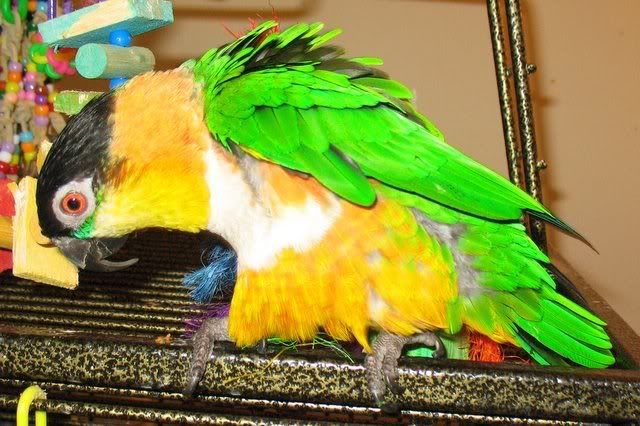
Isn't he gorgeous? When we first got him, his wings and tail were entirely green; as he's aged, more yellow and orange have crept in. He also has a few orange feathers that have started to grow in his black cap.
When that proved fruitless, he climbed up on me and tried to eat food that I was trying to feed myself. I would have loved to get some pictures of that! He is pretty determined.
He's still extremely hormonal, so he remains in the kitchen. It's very hard to strike a balance between giving him a proper amount of attention and getting him too worked up.
Of course, he ate this up. Just as Rocky wishes that I would leave Thomas so he could have him to himself, Calypso wishes that I were the only human he lived with. Actually, I'm pretty sure he wishes it were just the two of us and that there weren't any other parrots around, either!
In any case, he started to try to eat seeds that were in a container on the table:
Isn't he gorgeous? When we first got him, his wings and tail were entirely green; as he's aged, more yellow and orange have crept in. He also has a few orange feathers that have started to grow in his black cap.
When that proved fruitless, he climbed up on me and tried to eat food that I was trying to feed myself. I would have loved to get some pictures of that! He is pretty determined.
He's still extremely hormonal, so he remains in the kitchen. It's very hard to strike a balance between giving him a proper amount of attention and getting him too worked up.
Butternut squash
Yesterday morning, I was cubing up butternut squash in order to make a slow-cooker dinner. Max kept dancing and saying "want some!" I explained that she didn't want to eat raw squash, but she insisted. Finally, I gave in, and she did eat a few bites.
I guess she knows better than me what she wants, but I'm still not eating this raw.
Subscribe to:
Posts (Atom)