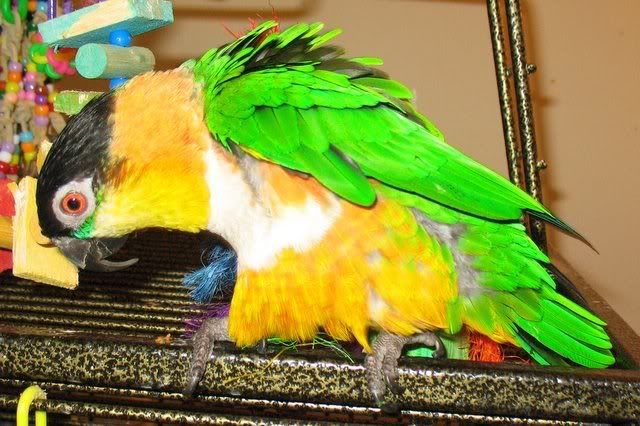
Even though Rocky has not had his flight feathers cut for quite a long time, he still rarely flies. I guess that's understandable since he was into his 20s before learning to fly. We're trying to change that, so he gets more exercise.
Thomas usually has him step up and ferries him into the living room. I had hoped he would follow Thomas of his own volition (flying) but when that didn't happen, I had to help things along:
He still doesn't get as much lift as I'd like, though he can make it to the shower curtain from the floor, so he is making progress. He's really good at landing, taking corners, flying down, and making changes mid-air. Pretty much all we need to work on is stamina and taking off on his own.
If only it were as big of a priority for him as it is for us, he could be as proficient as the greys in our house.
Showing posts with label flight. Show all posts
Showing posts with label flight. Show all posts
Friday, June 3, 2011

Friday, April 1, 2011
Weapon of Choice
Max has been using herself as a weapon against Thomas lately. He'll just be minding his own business, and she'll suddenly fly into him at full speed. Last night, she hit into his head so hard he was worried she may have injured herself.
This was not the case, as she did it again this morning. He said it was kind of a blur, but he remembers her feet heading toward him "like a raptor!" Then the collision; finally, pain on the side of his head. When he looked up, Max was on her stand, preening herself as if nothing had happened.
Max is a very good flyer, so this is clearly intentional. I suspect it's hormonally-driven. He's promised to be more alert so he can duck.
This was not the case, as she did it again this morning. He said it was kind of a blur, but he remembers her feet heading toward him "like a raptor!" Then the collision; finally, pain on the side of his head. When he looked up, Max was on her stand, preening herself as if nothing had happened.
Max is a very good flyer, so this is clearly intentional. I suspect it's hormonally-driven. He's promised to be more alert so he can duck.
Monday, March 28, 2011
Crash landing
When Brian was surrendered to the rescue, his wings were clipped. Unfortunately, the facility does not have a way to keep flighted birds safe, so that's standard policy. He's molting right now, which means he has some flight feathers growing in.
He's still learning to fly (obviously) and doesn't always do so gracefully, which is to be expected. We hope to allow him to fly, assuming that it can be done so safely with the much larger parrots in our house.
Last night, he decided to take off. I'm not sure where his intended destination was, but I doubt it was a kitchen drawer:
He's still learning to fly (obviously) and doesn't always do so gracefully, which is to be expected. We hope to allow him to fly, assuming that it can be done so safely with the much larger parrots in our house.
Last night, he decided to take off. I'm not sure where his intended destination was, but I doubt it was a kitchen drawer:

Tuesday, August 24, 2010
Max in flight
Thomas took a great picture of Max yesterday: I was (sadly) away at a meeting, so he was alone with the parrots again.
Everyone had been in the living room, then the greys flew into the kitchen. After a while, he realized that they were suspiciously quiet, so he went into the kitchen to check on them.
Max and Stella were hanging out on top of the fridge (where they are not allowed) behind the salad spinner. He said that they weren't fighting, so his first thought was to get a picture for me for the blog. He went to snap that picture, but Max had other (better) plans.
When she's on top of the fridge, she doesn't like us taking a picture, so she'll buzz us when she sees the camera, which is what she's about to do here. Thomas said that after taking this picture, she slammed into his head. Both of them were just fine.
If you look closely behind Max's right wing, you can see Stella's feet, still on top of the fridge.
 I was (sadly) away at a meeting, so he was alone with the parrots again.
Everyone had been in the living room, then the greys flew into the kitchen. After a while, he realized that they were suspiciously quiet, so he went into the kitchen to check on them.
Max and Stella were hanging out on top of the fridge (where they are not allowed) behind the salad spinner. He said that they weren't fighting, so his first thought was to get a picture for me for the blog. He went to snap that picture, but Max had other (better) plans.
When she's on top of the fridge, she doesn't like us taking a picture, so she'll buzz us when she sees the camera, which is what she's about to do here. Thomas said that after taking this picture, she slammed into his head. Both of them were just fine.
If you look closely behind Max's right wing, you can see Stella's feet, still on top of the fridge.
Friday, July 2, 2010
Question on flight
I received the following question in the comments of this post. Since my answer is likely to be long, I decided to turn it into a post instead of responding in the comments:
So, on to some of my ramblings in answering the first question about behavioral problems due to flight. In my house, all of my current birds (except our foster bird who has only been with us 4 days and therefore hasn't grown out his flight feathers) have the ability to fly.
Max (TAG), Stella (CAG), and Beeps (BHC) are really good flyers. They most frequently choose flight at their transportation method. Calypso (BHC) almost never flies. I do toss him to his stand or cage, and he likes that, but his preferred transportation method is leaning where he wants to go and beeping until I take him there. Rocky (severe macaw) has just begun flying down to the ground, but usually walks where he wants to go. Therefore, even having a flighted bird, does not guarantee flight! However, since the grey in question is already gliding down to the ground, I'd expect him to pick up flying quite quickly.
Since you specifically mention your grey, I will mostly restrict my observations to my own greys. We had Max for around 4-5 years before we allowed her to fly. We never even considered allowing her to fly for the first few years -- clipping was just what good parrot owners do. Plus, every time her flight feathers would grow in, and she could fly a bit, her personality would change. She got snippier, harder to control. As soon as we clipped her, we got our sweet Max back.
After Max had her feather destruction issues in 2006, I did a ton of research and allowing her to fly was one of the things we decided to try to optimize her environment so she would stop plucking. It was one of the best parrot-keeping decisions we ever made.
In the article linked to above, Pam Clark makes the following statement, and I couldn't agree more:
That being said, having a flying bird can be much more of a challenge, especially in the beginning when you're redefining behavior expectations.
Of course, there are the safety aspects. We use a double door policy to ensure that no one escapes. We make sure no one is perched on top of an open door before we close it.
There's also the potential damage to your house, which is magnified when the bird can go wherever they want.
And the poop issue, which I will touch on more later.
I think also a major mind set change needs to take place for some people when a bird can fly. At least it did for us! When your bird is clipped, generally you can put him/her on a perch and she stays there. (This isn't true for all birds -- Rocky proves that as he just climbs down from the perch and goes where he wants.) When the bird is flighted, he can go wherever he wants. So you have to work in conjunction with your bird to make sure that appropriate perching places are where the bird wants to be. The relationship becomes much more of a partnership.
Proper training is a must! I know some people who brag they have flighted birds. However, they haven't trained their birds on acceptable flighted behavior, so the birds spend almost all of their time in their cages because they get into trouble otherwise. How is it a benefit to the bird to be able to fly if they are now cage bound?
With both of our greys, the first few weeks after they realized they could fly were quite trying. In a sense, I think of it like a child with controlling parents who goes off to college and goes wild. For so long, we controlled where our greys went, and suddenly, they realized they could go wherever they want! If we wanted them to step up, they could just fly away! We just worked through this period, and after a few weeks, after the novelty of flying wore off, things were fine. I must add, though, that our bird sitter still has problems with Max just flying away instead of going in her cage. She has to use cashews to bribe Max to go inside.
We changed our approach to the parrots -- making acceptable perching places attractive and not allowing them on unacceptable places. Teaching them recall, which is a fun game, gets them off of unacceptable places, and should hopefully help us to recover them should they, despite our best efforts, ever get loose outside.
One great benefit to flying is the exercise aspect. While it's possible for non-flighted birds to get exercise, it's far easier when they're flying. We've noticed huge behavioral improvements in our birds when they get panting several times a day. I know how squirrelly I get when I don't run for a couple of days. Imagine these natural athletes, who in the wild would be flying all of the time, denied that possibility. Flying/exercising gives them a positive outlet for their energy. Max almost never squawks in displeasure anymore -- her vocalizations are pleasant. If she's unhappy, she can move somewhere else.
Looking back on things, in the short term, allowing a previously non-flighted bird to fly can be a lot of work. There's additional training, getting used to the improved safety measures, etc. But, in the long term, I think it's actually easier to live with flighted birds. They are so much more enjoyable to be around; they show off more of their personality. In addition, when we go from the kitchen to living room, instead of making a ton of trips ferrying the parrots from perches to cages, they either follow us by themselves, or we toss them into the other room.
As for your second question, our birds are not trained to poop in one place, so I'm not sure how much help I'll be here! When our greys come out of their cages, we hold them over the trash can and they both eliminate then, but subsequent eliminations happen wherever they are. That's part of the reason we don't have any carpet in the areas of the house where they are allowed! We watch them closely and try to clean them up as soon as they happen. We also wash our floors very regularly.
However, with training, a flighted bird, especially one who is already trained, could be taught to fly to a certain perch to go.
One final thing to consider, especially with regards to greys, is the issue of heart disease. If you google "african grey heart disease" many links come up. The vet at the rescue where I volunteer is generally anti-flight for parrots, as she believes that most families are not equipped to live safely with a flighted bird. Even she recommends that people with greys allow them to fly, for health reasons.
I hope this was somewhat helpful, but if I didn't answer something completely, or if you have any other questions, as always, please feel free to ask again. I'm certainly no expert, but am always happy to share my experiences!
Speaking of negative behavior, do you have any behavioral problems allowing the birds full flight? What about poop? My CAG is clipped but does take off for short flights to the ground. I've been thinking about not clipping (cats) but he is potty trained right now and I do not want to lose that. Thoughts?As always, thanks for the question! Personally, I am pro-flight as long as the situation is safe for the parrots and people in the house, so my response is likely to be biased in that direction! While I do recognize that each family needs to make the clip or not decision based on their individual circumstances and those of the bird, I feel that far too many make the clip decision. The article that made the biggest impact on me, and was the impetus for allowing Max's flight feathers to grow out is "Feathers, Flight, and Parrot Keeping" by Pam Clark.
So, on to some of my ramblings in answering the first question about behavioral problems due to flight. In my house, all of my current birds (except our foster bird who has only been with us 4 days and therefore hasn't grown out his flight feathers) have the ability to fly.
Max (TAG), Stella (CAG), and Beeps (BHC) are really good flyers. They most frequently choose flight at their transportation method. Calypso (BHC) almost never flies. I do toss him to his stand or cage, and he likes that, but his preferred transportation method is leaning where he wants to go and beeping until I take him there. Rocky (severe macaw) has just begun flying down to the ground, but usually walks where he wants to go. Therefore, even having a flighted bird, does not guarantee flight! However, since the grey in question is already gliding down to the ground, I'd expect him to pick up flying quite quickly.
Since you specifically mention your grey, I will mostly restrict my observations to my own greys. We had Max for around 4-5 years before we allowed her to fly. We never even considered allowing her to fly for the first few years -- clipping was just what good parrot owners do. Plus, every time her flight feathers would grow in, and she could fly a bit, her personality would change. She got snippier, harder to control. As soon as we clipped her, we got our sweet Max back.
After Max had her feather destruction issues in 2006, I did a ton of research and allowing her to fly was one of the things we decided to try to optimize her environment so she would stop plucking. It was one of the best parrot-keeping decisions we ever made.
In the article linked to above, Pam Clark makes the following statement, and I couldn't agree more:
From personal experience, I believe that flighted birds are more fun to have as companions. They are so much better able to reveal their personalities through movement of choice.Max's relationship with us has blossomed in ways we never could have imagined when she was clipped!
That being said, having a flying bird can be much more of a challenge, especially in the beginning when you're redefining behavior expectations.
Of course, there are the safety aspects. We use a double door policy to ensure that no one escapes. We make sure no one is perched on top of an open door before we close it.
There's also the potential damage to your house, which is magnified when the bird can go wherever they want.
And the poop issue, which I will touch on more later.
I think also a major mind set change needs to take place for some people when a bird can fly. At least it did for us! When your bird is clipped, generally you can put him/her on a perch and she stays there. (This isn't true for all birds -- Rocky proves that as he just climbs down from the perch and goes where he wants.) When the bird is flighted, he can go wherever he wants. So you have to work in conjunction with your bird to make sure that appropriate perching places are where the bird wants to be. The relationship becomes much more of a partnership.
Proper training is a must! I know some people who brag they have flighted birds. However, they haven't trained their birds on acceptable flighted behavior, so the birds spend almost all of their time in their cages because they get into trouble otherwise. How is it a benefit to the bird to be able to fly if they are now cage bound?
With both of our greys, the first few weeks after they realized they could fly were quite trying. In a sense, I think of it like a child with controlling parents who goes off to college and goes wild. For so long, we controlled where our greys went, and suddenly, they realized they could go wherever they want! If we wanted them to step up, they could just fly away! We just worked through this period, and after a few weeks, after the novelty of flying wore off, things were fine. I must add, though, that our bird sitter still has problems with Max just flying away instead of going in her cage. She has to use cashews to bribe Max to go inside.
We changed our approach to the parrots -- making acceptable perching places attractive and not allowing them on unacceptable places. Teaching them recall, which is a fun game, gets them off of unacceptable places, and should hopefully help us to recover them should they, despite our best efforts, ever get loose outside.
One great benefit to flying is the exercise aspect. While it's possible for non-flighted birds to get exercise, it's far easier when they're flying. We've noticed huge behavioral improvements in our birds when they get panting several times a day. I know how squirrelly I get when I don't run for a couple of days. Imagine these natural athletes, who in the wild would be flying all of the time, denied that possibility. Flying/exercising gives them a positive outlet for their energy. Max almost never squawks in displeasure anymore -- her vocalizations are pleasant. If she's unhappy, she can move somewhere else.
Looking back on things, in the short term, allowing a previously non-flighted bird to fly can be a lot of work. There's additional training, getting used to the improved safety measures, etc. But, in the long term, I think it's actually easier to live with flighted birds. They are so much more enjoyable to be around; they show off more of their personality. In addition, when we go from the kitchen to living room, instead of making a ton of trips ferrying the parrots from perches to cages, they either follow us by themselves, or we toss them into the other room.
As for your second question, our birds are not trained to poop in one place, so I'm not sure how much help I'll be here! When our greys come out of their cages, we hold them over the trash can and they both eliminate then, but subsequent eliminations happen wherever they are. That's part of the reason we don't have any carpet in the areas of the house where they are allowed! We watch them closely and try to clean them up as soon as they happen. We also wash our floors very regularly.
However, with training, a flighted bird, especially one who is already trained, could be taught to fly to a certain perch to go.
One final thing to consider, especially with regards to greys, is the issue of heart disease. If you google "african grey heart disease" many links come up. The vet at the rescue where I volunteer is generally anti-flight for parrots, as she believes that most families are not equipped to live safely with a flighted bird. Even she recommends that people with greys allow them to fly, for health reasons.
I hope this was somewhat helpful, but if I didn't answer something completely, or if you have any other questions, as always, please feel free to ask again. I'm certainly no expert, but am always happy to share my experiences!
Wednesday, June 16, 2010
Rocky's flying (a bit)
We've been working with Rocky on flight. He came to us, at age 19, having been locked in a cage for at least 6 years. No flying there! We traced his leg band and found out he was hatched, in 1987, at one of the worst bird mills around (similar to puppy mills). Probably not fledged!
We had to keep his wings clipped for the first several years he lived with us, as he would use his ability to fly for evil -- namely, attacking me aerially.
Over the years, as we've refined our relationship, he's appeared to have decided not to attack while flighted, so he's had his wings for quite a few months now.
One of the things I've always heard, and that is certainly true for Max, is that flying down in a lot harder than flying up. That's not the case for Stella and Rocky! When Stella first came to us, the first flying she did was to the ground. Now, she flies wherever she wants to, but will frequently fly to the floor. Max never flies to the floor -- if she wants to get down there, she climbs. I wonder if this has anything to do with the ages they were when they learned to fly? Max was a baby and Stella and Rocky were adults.
Here's a video of Rocky, flying down. Sometimes he takes a running start, but the table was full of clutter, so he didn't do that here.
He's getting much better at navigating; yesterday he was about to fly into our patio doors (I feared the worst) but managed a U-turn just in time to avert disaster. Who knows if he'll ever choose flying as his main method of transportation, as the greys have, but at least he can.
We had to keep his wings clipped for the first several years he lived with us, as he would use his ability to fly for evil -- namely, attacking me aerially.
Over the years, as we've refined our relationship, he's appeared to have decided not to attack while flighted, so he's had his wings for quite a few months now.
One of the things I've always heard, and that is certainly true for Max, is that flying down in a lot harder than flying up. That's not the case for Stella and Rocky! When Stella first came to us, the first flying she did was to the ground. Now, she flies wherever she wants to, but will frequently fly to the floor. Max never flies to the floor -- if she wants to get down there, she climbs. I wonder if this has anything to do with the ages they were when they learned to fly? Max was a baby and Stella and Rocky were adults.
Here's a video of Rocky, flying down. Sometimes he takes a running start, but the table was full of clutter, so he didn't do that here.
He's getting much better at navigating; yesterday he was about to fly into our patio doors (I feared the worst) but managed a U-turn just in time to avert disaster. Who knows if he'll ever choose flying as his main method of transportation, as the greys have, but at least he can.
Friday, March 19, 2010
Fight or flight
Occasionally something scary happens. These events are perceived only by the parrots, and usually only by the greys. The humans are extremely perplexed as to what these scary events are. There is no pattern.
In any case, something happens, and both greys take off, flying around the house. Usually the other parrots don't participate in this madness; however, occasionally a grey will fly into another parrot, forcing them to take off.
That's what happened this morning. Calypso got mixed up in their ridiculousness, through no fault of his own. Calypso isn't the greatest flier, so this morning he landed in a weird spot and then made begging noises until I had him step up on my hand and replaced him on his stand.
After their several second fly about, the greys were fine.
In any case, something happens, and both greys take off, flying around the house. Usually the other parrots don't participate in this madness; however, occasionally a grey will fly into another parrot, forcing them to take off.
That's what happened this morning. Calypso got mixed up in their ridiculousness, through no fault of his own.
 Calypso isn't the greatest flier, so this morning he landed in a weird spot and then made begging noises until I had him step up on my hand and replaced him on his stand.
After their several second fly about, the greys were fine.
Tuesday, January 19, 2010
Recycling Rocky
Earlier this week, Rocky was being very demanding. Nothing was making him happy. Thomas decided he needed a change of scenery, so he wrapped him up and put him in our paper recycling box.
They do strange things like this frequently. As always, I would not recommend doing any sort of thing like this with a typical parrot -- they will just get angry and maybe fearful. But Rocky loves this kind of attention.
The main reason I'm posting this is because of the way he uses his wings to fly down from the box. A month ago he would have either tried to climb down from the box or screamed until Thomas or I rescued him. Since it's likely that he didn't have the opportunity to learn to fly until he was in his 20s, I'm not sure how skillful he'll become, but it will be interesting to watch!
They do strange things like this frequently. As always, I would not recommend doing any sort of thing like this with a typical parrot -- they will just get angry and maybe fearful. But Rocky loves this kind of attention.
The main reason I'm posting this is because of the way he uses his wings to fly down from the box. A month ago he would have either tried to climb down from the box or screamed until Thomas or I rescued him. Since it's likely that he didn't have the opportunity to learn to fly until he was in his 20s, I'm not sure how skillful he'll become, but it will be interesting to watch!
Monday, November 30, 2009
Natural Birdsmanship: An important article
About a year ago, I had read this article, which reaffirmed some of my thinking on the lives we give our parrots, and which made me consider changes we might make. I resolved to read it every few months as a refresher, and then promptly put it away and forgot about it until I stumbled upon it last night. I really think it is the most important article I have ever read about keeping captive parrots, and highly recommend it.
Last night, as I was rereading, I kept interrupting Thomas to read him a line, and I thought how I wanted to write about this on the blog. I apologize in advance for the long entry!
The article discusses different roles parrots take in their flocks in the wild. This part made me think of Max, and how she'll often go off and explore the kitchen instead of staying with us in the living room:
Moving on to Rocky, the article next discusses reproductively active birds:
I could quote almost the whole article, but I'm trying to stick to only the most pertinent parts:
Rocky will often act as though he doesn't want me around, but then he'll scream when I'm in another room and only calms down when the entire flock is together again. He'll climb up on the couch and want to be near me, though if I tried to touch him, he'd bite. He'll follow me around the house, usually with his wings spread, threatening me, though not inflicting any real damage (or even trying to) -- just warning me. He has certain games that he plays with me, like fetch or copying the noises I make.
He also knows that Thomas will not tolerate any violence against me. Every time he's attacked me, Thomas has been in another room, or his back was turned. Last week, Thomas and I were reading the paper at the kitchen table and Rocky was walking around the table. He walked to the end of the table, inches away from me, spread his wings, and swayed slightly. Trying to threaten and intimidate me. Thomas told me to just ignore him to see what he did. He got frustrated that his threats weren't working against me (I stayed at the table), so he started swaying more and saying "Hello!" Finally I acknowledged him, and then he went back over to Thomas. The entire time, he was well within striking range and could have bitten me, but didn't.
On the topic of excessive screaming (a problem with Rocky):
On flying:
I could quote many more parts of this article, but just hope that interested parrot owners will read the article as I'm missing much here! However, I did want to quote a paragraph in his conclusion, as I feel it is an almost perfect summary, and what we try to achieve with our parrots:
EDIT: Oops! Beloved Parrot pointed out that I didn't even mention the author! It's written by Dr. Michael Doolan, DVM, and here is a link to the pdf of the article.
Last night, as I was rereading, I kept interrupting Thomas to read him a line, and I thought how I wanted to write about this on the blog. I apologize in advance for the long entry!
The article discusses different roles parrots take in their flocks in the wild. This part made me think of Max, and how she'll often go off and explore the kitchen instead of staying with us in the living room:
"It is necessary for some members to venture outside the safety of the flock territory and look for new resources...A few pet birds that have been allowed to develop the social maturity and self confidence necessary to assume this role will begin to show this tendency...[the bird] will actually move away from the owner to find new areas to explore."Our goal has always been to try to raise her to be self-confident and self-reliant. To accept responsibility for her own happiness instead of relying on Thomas and me to provide it.
Moving on to Rocky, the article next discusses reproductively active birds:
"In the case of most species, the male does most of this nest building while the female guards the nest territory. When the nest is ready, they switch roles and the female stays in the nest while the male assumes the guardian and food-acquisition role"In our case, Rocky (the male) chips up wood and destroys newspapers, building a nest for he and Thomas (the female) to share. After chipping wood, he'll frequently try to feed Thomas's feet.
I could quote almost the whole article, but I'm trying to stick to only the most pertinent parts:
"Another manifestation of the phenomenon of human/bird mate bonding is the territorial aggression that is sometimes seen in the human/bird flock...In the flock, there are intraflock boundaries that are set into place based on the dominance hierarchy...The bird does not usually "hate" the injured human, as is commonly thought, but rather is just doing its job. In fact, the human usually is a needed part of the bird's flock who simply does nit understand these rules."This! In our minds, Thomas and I are the bonded pair, but in Rocky's mind, he's in a mate relationship with Thomas, though Thomas does try to discourage this. I've written before that Rocky and I have a very unusual relationship -- one that, though I think about a lot, I haven't quite figured out.
Rocky will often act as though he doesn't want me around, but then he'll scream when I'm in another room and only calms down when the entire flock is together again. He'll climb up on the couch and want to be near me, though if I tried to touch him, he'd bite. He'll follow me around the house, usually with his wings spread, threatening me, though not inflicting any real damage (or even trying to) -- just warning me. He has certain games that he plays with me, like fetch or copying the noises I make.
He also knows that Thomas will not tolerate any violence against me. Every time he's attacked me, Thomas has been in another room, or his back was turned. Last week, Thomas and I were reading the paper at the kitchen table and Rocky was walking around the table. He walked to the end of the table, inches away from me, spread his wings, and swayed slightly. Trying to threaten and intimidate me. Thomas told me to just ignore him to see what he did. He got frustrated that his threats weren't working against me (I stayed at the table), so he started swaying more and saying "Hello!" Finally I acknowledged him, and then he went back over to Thomas. The entire time, he was well within striking range and could have bitten me, but didn't.
On the topic of excessive screaming (a problem with Rocky):
"In the human/bird flock, communication is still a necessary activity. If the bird is confident and the flock is stable, this vocalization is usually limited to a short round in the morning and again in the evening. In the case of the bird that lacks self confidence and a feeling of security, vocalization becomes more frantic as a means of calling for the safety of the human flock members."While we do the best to instill self confidence in our parrots, I think they are still affected by their previous experiences. Rocky was 19 when we got him, and had previously been quite neglected and shut away from all other beings. He almost never screams when the entire flock is in the same room. He also becomes very frantic about saying "Bye bye" when we leave the house or when we go upstairs, so I think this is a major issue with him. I think it will just take time, and hopefully if he's able to develop flight skills, that will also help with his self confidence and feeling of security.
On flying:
"If the author's pet severe macaw flies to a location he knows is off limits and refuses to obey the "off" command, he will get gently pushed off the location, forcing him to fly to a location that he is allowed to occupy. When he shows acceptance of this situation, he is rewarded for this acceptance with attention. It obviously would not be fair or appropriate to "discipline" naturally in this way unless the bird is a master flier."We do this with our greys, though as he said, we didn't do it with Stella until she became a competent flier. We would do this with Beeps, but he only perches on acceptable perches.
I could quote many more parts of this article, but just hope that interested parrot owners will read the article as I'm missing much here! However, I did want to quote a paragraph in his conclusion, as I feel it is an almost perfect summary, and what we try to achieve with our parrots:
"Key to the successful resolution of most behavior problems are the following: understanding the natural instincts and the basis for flock and individual behaviors; allowing and encouraging the development of a higher degree of parental independence and self confidence through flight; and developing a healthy natural flock social environment by establishing a structure of authority with mutual trust and respect."Obviously, if you've spent any time reading my blog, we're not there yet. In fact, since owning parrots is not a destination, I don't know that we'll ever be "there." But we're heading in the right direction, and thanks for joining us on this ride!
EDIT: Oops! Beloved Parrot pointed out that I didn't even mention the author! It's written by Dr. Michael Doolan, DVM, and here is a link to the pdf of the article.
Wednesday, November 11, 2009
Flying
Finally, I am getting around to answering Pamela's question of a few days ago:
First, congratulations to Harley on growing his wing feathers! I am a huge proponent of flight, as long as it can be done safely. I believe that it's an individual decision that depends on the bird as well as the living conditions of the bird, but it always makes me happy when another parrot can safely be allowed to fly!
Max was the first of our birds to fly, and it brought out parts of her personality that we'd only glimpsed previously. It made her so much more fun and enjoyable to be around as she gained confidence in her skills.
As I mentioned here, two of our unfledged parrots have become great flyers (Beeps & Stella), two are acceptable flyers (Calypso & Daphne; they never choose to fly but can safely make it to their cage or stand if we launch them into the air), and one has no flight skills (Rocky). Max was fledged and is an excellent flyer.
As with most parrot-training subjects, I don't believe there's a one-size-fits-all approach to teaching an adult parrot to fly. I believe you have to observe your parrot and work out a system that will work for them. That being said, of course I will outline what we did with our birds.
1. Before they had their flight feathers back, we worked with them on flapping exercises. Birds who don't fly have atrophied flight muscles. Below is a video of Stella from June 2008 when her wings were clipped. We got her to start flapping by saying "flap" every time she flapped on her own so that she'd start to associate the word "flap" with her motions. And praise her! Then, I'd have her perch on my hand, like in the video, and move my hand up and down, which will often produce a flapping in parrots to help them become more stable. Some parrots might be uncomfortable with this, so watch their body language and don't make them go too fast! Stella loved it.
2. In my mind, there are three main components to flying: the take-off, the flight, and the landing. The take-off seems to be mostly mental -- does the parrot think to fly to get where she wants to go? We don't work too much on that; however, we do work a lot with the flight and the landing, always working at the parrot's pace.
We try to work on landings first, since I imagine that must be pretty scary for a new flyer! I think the flight part is pretty instinctual, but it's the taking off, maneuvering, and landing that are skills they normally would have learned from their parrot parents.
What we normally do is Thomas and I stand close to each other, and launch the parrot back and forth, having them land on our arm. Our arms are wider than their perches, and this seems to work well.
"Launch" is a rather extreme word to explain what we do, though. It's more of a gentle motion, along with "Go to Thomas/Mary!" or "Go to your perch/cage!" and the other person presenting their arm and encouraging, "Come here!"
In this video, I launch Max to the treadmill:
As the parrot gets comfortable with landing, I'll move on to launching them to a perch or to their cage, as Thomas tends to get tired of working on this much more quickly than I do. I usually start pretty close to the intended landing point, and slowly go further away so that they fly a longer distance before landing.
As always, work at the pace of the parrot. This may take a day, or it may take weeks.
3. After the parrot seems to be able to land well, we work on flight skills. Once again, in my experience, parrots tend to be able to fly straight and up fairly well (as long as they have developed muscles). It's getting around unexpected obstacles, turning corners, and going down that we work on.
Unexpected obstacles can be dangerous. If a parrot is flying quickly and a door that they expect to be open is closed, they could crash into the door and cause problems. From my experience, it's not as dangerous when they crash as they're learning because their muscles are not fully developed and they're flying more slowly than normal, so a crash has less of an impact. Therefore, I feel it's important to try to teach them important flight skills before their muscles get too developed.
What we do is work on going around corners first. I'll place the intended landing perch (human or otherwise) around a corner, but still in sight of the parrot, then gently launch the parrot and praise when they go on the perch. Once that's easy, we go a little further back, until they can't see their intended landing perch when I launch them. Again, depending on the parrot, this might happen in one training session, or it may take many.
For U-turns, I'll launch the parrot in the opposite direction of their favorite perch; all of them quickly learned to turn around.
Flying down is also important, as if something unforeseen happens and the parrot gets outside, being able to fly down might save their life. We work on this by putting the parrot on a high perch and calling them to us. Then squatting down and calling them to us. Sometimes we put them at the top of the stairs for them to fly down. This has taken us longer than any other step!
4. Once the parrot has a pretty good grasp on these basic concepts, we start working on things like flighted recall and flighted retrieve. Flighted recall is calling the bird to you, and may also be key in retrieving a bird that accidentally gets outside. Flighted retrieve is having the bird bring an object to you -- it's a fun way of working on flight skills and exercising your parrot's body and brain at the same time.
As for actually living with flighted parrots, once we got used to it and more or less had them trained on what perches were acceptable, I find it easier to live with them flighted. Instead of making multiple trips from the living room to kitchen in order to have them in the same room with us, I can launch them into the living room and tell them to go to their cage, or they automatically follow us into the kitchen.
We do have to be careful about certain things, but these have become almost second nature over the years. For example, we are very strict about our double door policy. We usually go in and out through our attached garage. When I'm coming home in the car, I don't open the door from the garage to the kitchen until the garage door is completely shut. If someone knocks on our front door, I either don't answer, or I exit through the garage door and surprise them by coming from the side. Our next house will definitely have an enclosed porch! This is one of the main reasons we don't have a dog -- there is no safe and easy way for us to let the dog outside while maintaining the safety of the birds.
We only have one ceiling fan, in our bedroom upstairs, a room the parrots are not supposed to enter, though they sometimes sneak in. If the fan is on, the bedroom door is shut. We don't close any doors in the house without first checking to make sure no one is perched on top (I almost smashed Max's toes once when she landed on our basement door while I was in the basement. After I got back upstairs, I closed the door and was surprised to hear Max screech in pain and fly away. Luckily, she was not injured, but we are now very careful!)
In addition, there are some of the less important, and rather funny things, like not ever having any unsupervised cheese out or knowing that unsupervised bananas might be destroyed at any time.
I feel as though I've been going on and on and I'm not even sure if I answered your question properly, so please let me know if I have been unclear, or if you have additional questions! A s always, I'm not an expert -- it's just what's worked for us in our house! I can't wait to read Harley flying updates on your blog!
Do you have suggestions, or can you point me to some of your blog posts about having a flighted bird? Harley has most of his wing feathers back, and I love the idea of having a flighted bird. But he needs some practice landing. And I haven't had a flighted bird since Peanut the parrotlet - he was so small, that his flying was a very different thing than Harley. No territorial issues so far, just a bigger, flying, clumsy bird.
Thanks!
First, congratulations to Harley on growing his wing feathers! I am a huge proponent of flight, as long as it can be done safely. I believe that it's an individual decision that depends on the bird as well as the living conditions of the bird, but it always makes me happy when another parrot can safely be allowed to fly!
Max was the first of our birds to fly, and it brought out parts of her personality that we'd only glimpsed previously. It made her so much more fun and enjoyable to be around as she gained confidence in her skills.
As I mentioned here, two of our unfledged parrots have become great flyers (Beeps & Stella), two are acceptable flyers (Calypso & Daphne; they never choose to fly but can safely make it to their cage or stand if we launch them into the air), and one has no flight skills (Rocky). Max was fledged and is an excellent flyer.
As with most parrot-training subjects, I don't believe there's a one-size-fits-all approach to teaching an adult parrot to fly. I believe you have to observe your parrot and work out a system that will work for them. That being said, of course I will outline what we did with our birds.
1. Before they had their flight feathers back, we worked with them on flapping exercises. Birds who don't fly have atrophied flight muscles. Below is a video of Stella from June 2008 when her wings were clipped. We got her to start flapping by saying "flap" every time she flapped on her own so that she'd start to associate the word "flap" with her motions. And praise her! Then, I'd have her perch on my hand, like in the video, and move my hand up and down, which will often produce a flapping in parrots to help them become more stable. Some parrots might be uncomfortable with this, so watch their body language and don't make them go too fast! Stella loved it.
2. In my mind, there are three main components to flying: the take-off, the flight, and the landing. The take-off seems to be mostly mental -- does the parrot think to fly to get where she wants to go? We don't work too much on that; however, we do work a lot with the flight and the landing, always working at the parrot's pace.
We try to work on landings first, since I imagine that must be pretty scary for a new flyer! I think the flight part is pretty instinctual, but it's the taking off, maneuvering, and landing that are skills they normally would have learned from their parrot parents.
What we normally do is Thomas and I stand close to each other, and launch the parrot back and forth, having them land on our arm. Our arms are wider than their perches, and this seems to work well.
"Launch" is a rather extreme word to explain what we do, though. It's more of a gentle motion, along with "Go to Thomas/Mary!" or "Go to your perch/cage!" and the other person presenting their arm and encouraging, "Come here!"
In this video, I launch Max to the treadmill:
As the parrot gets comfortable with landing, I'll move on to launching them to a perch or to their cage, as Thomas tends to get tired of working on this much more quickly than I do. I usually start pretty close to the intended landing point, and slowly go further away so that they fly a longer distance before landing.
As always, work at the pace of the parrot. This may take a day, or it may take weeks.
3. After the parrot seems to be able to land well, we work on flight skills. Once again, in my experience, parrots tend to be able to fly straight and up fairly well (as long as they have developed muscles). It's getting around unexpected obstacles, turning corners, and going down that we work on.
Unexpected obstacles can be dangerous. If a parrot is flying quickly and a door that they expect to be open is closed, they could crash into the door and cause problems. From my experience, it's not as dangerous when they crash as they're learning because their muscles are not fully developed and they're flying more slowly than normal, so a crash has less of an impact. Therefore, I feel it's important to try to teach them important flight skills before their muscles get too developed.
What we do is work on going around corners first. I'll place the intended landing perch (human or otherwise) around a corner, but still in sight of the parrot, then gently launch the parrot and praise when they go on the perch. Once that's easy, we go a little further back, until they can't see their intended landing perch when I launch them. Again, depending on the parrot, this might happen in one training session, or it may take many.
For U-turns, I'll launch the parrot in the opposite direction of their favorite perch; all of them quickly learned to turn around.
Flying down is also important, as if something unforeseen happens and the parrot gets outside, being able to fly down might save their life. We work on this by putting the parrot on a high perch and calling them to us. Then squatting down and calling them to us. Sometimes we put them at the top of the stairs for them to fly down. This has taken us longer than any other step!
4. Once the parrot has a pretty good grasp on these basic concepts, we start working on things like flighted recall and flighted retrieve. Flighted recall is calling the bird to you, and may also be key in retrieving a bird that accidentally gets outside. Flighted retrieve is having the bird bring an object to you -- it's a fun way of working on flight skills and exercising your parrot's body and brain at the same time.
As for actually living with flighted parrots, once we got used to it and more or less had them trained on what perches were acceptable, I find it easier to live with them flighted. Instead of making multiple trips from the living room to kitchen in order to have them in the same room with us, I can launch them into the living room and tell them to go to their cage, or they automatically follow us into the kitchen.
We do have to be careful about certain things, but these have become almost second nature over the years. For example, we are very strict about our double door policy. We usually go in and out through our attached garage. When I'm coming home in the car, I don't open the door from the garage to the kitchen until the garage door is completely shut. If someone knocks on our front door, I either don't answer, or I exit through the garage door and surprise them by coming from the side. Our next house will definitely have an enclosed porch! This is one of the main reasons we don't have a dog -- there is no safe and easy way for us to let the dog outside while maintaining the safety of the birds.
We only have one ceiling fan, in our bedroom upstairs, a room the parrots are not supposed to enter, though they sometimes sneak in. If the fan is on, the bedroom door is shut. We don't close any doors in the house without first checking to make sure no one is perched on top (I almost smashed Max's toes once when she landed on our basement door while I was in the basement. After I got back upstairs, I closed the door and was surprised to hear Max screech in pain and fly away. Luckily, she was not injured, but we are now very careful!)
In addition, there are some of the less important, and rather funny things, like not ever having any unsupervised cheese out or knowing that unsupervised bananas might be destroyed at any time.
I feel as though I've been going on and on and I'm not even sure if I answered your question properly, so please let me know if I have been unclear, or if you have additional questions! A s always, I'm not an expert -- it's just what's worked for us in our house! I can't wait to read Harley flying updates on your blog!
Tuesday, November 10, 2009
My parrots and thier flight histories
When I first got Max, we clipped her wings. Everything we'd read back then (2001/2002 time frame) said that clipping wings was imperative for the bird's safety. We really didn't know any better and just blindly followed that advice.
After I started doing some more reading, specifically this article, we decided to allow our birds to fly. At that point, we had Max, Calypso, and Ethel, an amazing budgie. Since Max had been properly fledged as a baby, she took to flying instantly. Within days, she could get where she wanted, control speed, navigate unknown places; it was great to see.
Like Max, Ethel was an amazing flyer almost right from the start, despite the fact that she had a tumor that doubled her weight. Talk about strength training!
Calypso is another story -- despite the fact that he has the ability to fly, he very rarely chooses to do so, as in several times a month, and usually when he's trying to get back to his cage.
Daphne can fly, though, like Calypso, she rarely chooses to do so and when she does, is trying to get back to her cage.
Rocky has all of his flight feathers currently, but we'll see how long that lasts. He has not shown any inclination to fly. So far, all his flight feathers do is give him the idea to launch flying attacks on us, which are really jumping attacks but his open wings give him a bit longer of a target range so he can get us from further out.
Beeps is a surprisingly good flyer. Caiques are not known for their flying ability and Calypso bore that stereotype out. However, Beeps completely defies it! He was most likely not fledged and came to us with no flight skills. He'd occasionally fly into walls and make bad landings in the beginning. Even now, after a couple of years of flight under his belt, it appears as though flying takes him much more effort than it does the greys. However, he has mastered the ability to change direction mid-flight and land on precarious perches.
Stella's flight progress was also a pleasant surprise. I think she learned a lot from watching Max. She still isn't as steady as Max is -- she kind of wobbles from side to side mid-flight -- but she can navigate surprise barriers, land wherever she likes, and use flight as her primary mode of transportation.
This post is in response to Pamela's question in the comments from yesterday. I will write more (and actually answer the question) later this week -- hopefully tomorrow -- but I wanted to give my parrots' flight backgrounds so as to not muddy that future post.
After I started doing some more reading, specifically this article, we decided to allow our birds to fly. At that point, we had Max, Calypso, and Ethel, an amazing budgie. Since Max had been properly fledged as a baby, she took to flying instantly. Within days, she could get where she wanted, control speed, navigate unknown places; it was great to see.
Like Max, Ethel was an amazing flyer almost right from the start, despite the fact that she had a tumor that doubled her weight. Talk about strength training!
Calypso is another story -- despite the fact that he has the ability to fly, he very rarely chooses to do so, as in several times a month, and usually when he's trying to get back to his cage.
Daphne can fly, though, like Calypso, she rarely chooses to do so and when she does, is trying to get back to her cage.
Rocky has all of his flight feathers currently, but we'll see how long that lasts. He has not shown any inclination to fly. So far, all his flight feathers do is give him the idea to launch flying attacks on us, which are really jumping attacks but his open wings give him a bit longer of a target range so he can get us from further out.
Beeps is a surprisingly good flyer. Caiques are not known for their flying ability and Calypso bore that stereotype out. However, Beeps completely defies it! He was most likely not fledged and came to us with no flight skills. He'd occasionally fly into walls and make bad landings in the beginning. Even now, after a couple of years of flight under his belt, it appears as though flying takes him much more effort than it does the greys. However, he has mastered the ability to change direction mid-flight and land on precarious perches.
Stella's flight progress was also a pleasant surprise. I think she learned a lot from watching Max. She still isn't as steady as Max is -- she kind of wobbles from side to side mid-flight -- but she can navigate surprise barriers, land wherever she likes, and use flight as her primary mode of transportation.
This post is in response to Pamela's question in the comments from yesterday. I will write more (and actually answer the question) later this week -- hopefully tomorrow -- but I wanted to give my parrots' flight backgrounds so as to not muddy that future post.
Tuesday, March 24, 2009
Spring reminder
As nicer weather is upon us, I feel compelled to once again repeat the tale of the worst day (so far) of my life in hopes that it will save some other bird from a similar fate. Every year, I hear tales of people whose birds were lost because they took their bird "who never flies" outside.
In July 2005, I returned home from a 10 mile run to see my across-the-street neighbor wave me down. He wanted to chat; we'd just moved into the neighborhood the month before. He started asking me about my parrots -- with the windows open he could hear them in his house and was curious.
Even though Thomas and I had a rule that the parrots were never allowed outside unless in a secure carrier or harness, I wanted to make a good impression on my neighbor. Max was clipped and never tried to fly in the house -- she always perched nicely on my hand. I knew there was no wind (I'd been outside for well over an hour) -- what's the worst thing that would happen? If she took off, she'd fly into a neighbor's yard and I'd pick her up.
The people-pleasing aspect of my personality got me into trouble that day, and almost cost Max her life. Out of nowhere, a tiny gust of wind came, something spooked Max, and she took off over the rooftops of the houses across the street.
To make a long story short, we did find her, after she spent 34 hours outside. I lost her at 8 am on Thursday and we found her at 6 pm on Friday.
Here is a picture taken last weekend of the field in which she was found -- quite a way from my house. She landed just beyond a pond and just before a very busy road. The field is currently cut back, but she was in chest-high weeds. I cannot describe the horrible feelings I had when she was missing. It was entirely my fault. She could have been killed by a wild animal, mowed over, or just starved to death -- she doesn't have survival skills!
Here is a link to one of the best articles I've read about recovering a parrot that's lost outside.
Interestingly enough, after going through this ordeal, we later decided to allow Max to fly. Remember, when Max was lost, her flight feathers were clipped. Because of what we went through, we are fanatical about making sure that none of our parrots gets outside, unrestrained, again.
We have a double door policy in our house. We usually enter through our attached garage, but make sure that the garage door is completely shut before opening the door to the kitchen. On the rare occasion that we open the front door, we double check all of the parrots' cage doors. This means that usually people who ring our bell have left before we get there to see what they want!
We also take steps that we hope will provide us with a better chance of finding them should they somehow get outside. We work on contact calls. When Max was first missing, I was calling her name until I realized that she never responded when I called her name -- she responded to my whistle in the house, so I changed my tactic. Ultimately, we found her because she responded to Calypso's call. We'd walked by the place she was probably more than a hundred times searching for her and she didn't respond to us; we might have found her sooner had we worked on contact calls before she was lost.
Additionally, we work on recall with a special focus on flying down, as if they were in a tree. I'll place the flighted bird on a high place, like the top of the fridge or a door, and then squat down and call the bird to me.
I'm hoping I'll never have to test how well they know these skills, but it makes me feel more confident of being able to find them should something happen.
I'm very embarrassed that such a thing happened to one of my birds. It's my job to keep them safe and I failed. Luckily, Max survived and was no worse for wear. Instead of pretending this never happened, I tell people about it because many people believe that a clipped parrot can't fly, and that's not true. With the wind, Max was able to gain height and go much further than we thought possible.
In July 2005, I returned home from a 10 mile run to see my across-the-street neighbor wave me down. He wanted to chat; we'd just moved into the neighborhood the month before. He started asking me about my parrots -- with the windows open he could hear them in his house and was curious.
Even though Thomas and I had a rule that the parrots were never allowed outside unless in a secure carrier or harness, I wanted to make a good impression on my neighbor. Max was clipped and never tried to fly in the house -- she always perched nicely on my hand. I knew there was no wind (I'd been outside for well over an hour) -- what's the worst thing that would happen? If she took off, she'd fly into a neighbor's yard and I'd pick her up.
The people-pleasing aspect of my personality got me into trouble that day, and almost cost Max her life. Out of nowhere, a tiny gust of wind came, something spooked Max, and she took off over the rooftops of the houses across the street.
To make a long story short, we did find her, after she spent 34 hours outside. I lost her at 8 am on Thursday and we found her at 6 pm on Friday.
Here is a picture taken last weekend of the field in which she was found -- quite a way from my house. She landed just beyond a pond and just before a very busy road. The field is currently cut back, but she was in chest-high weeds.
 I cannot describe the horrible feelings I had when she was missing. It was entirely my fault. She could have been killed by a wild animal, mowed over, or just starved to death -- she doesn't have survival skills!
Here is a link to one of the best articles I've read about recovering a parrot that's lost outside.
Interestingly enough, after going through this ordeal, we later decided to allow Max to fly. Remember, when Max was lost, her flight feathers were clipped. Because of what we went through, we are fanatical about making sure that none of our parrots gets outside, unrestrained, again.
We have a double door policy in our house. We usually enter through our attached garage, but make sure that the garage door is completely shut before opening the door to the kitchen. On the rare occasion that we open the front door, we double check all of the parrots' cage doors. This means that usually people who ring our bell have left before we get there to see what they want!
We also take steps that we hope will provide us with a better chance of finding them should they somehow get outside. We work on contact calls. When Max was first missing, I was calling her name until I realized that she never responded when I called her name -- she responded to my whistle in the house, so I changed my tactic. Ultimately, we found her because she responded to Calypso's call. We'd walked by the place she was probably more than a hundred times searching for her and she didn't respond to us; we might have found her sooner had we worked on contact calls before she was lost.
Additionally, we work on recall with a special focus on flying down, as if they were in a tree. I'll place the flighted bird on a high place, like the top of the fridge or a door, and then squat down and call the bird to me.
I'm hoping I'll never have to test how well they know these skills, but it makes me feel more confident of being able to find them should something happen.
I'm very embarrassed that such a thing happened to one of my birds. It's my job to keep them safe and I failed. Luckily, Max survived and was no worse for wear. Instead of pretending this never happened, I tell people about it because many people believe that a clipped parrot can't fly, and that's not true. With the wind, Max was able to gain height and go much further than we thought possible.
Friday, December 26, 2008
Cockatiels!
We spent Christmas at my parents' house, which means we also spent time with their cockatiels. Every time I see these guys, I remember how much fun they are! Unfortunately, they are far too often overlooked, which is a shame because they might just be the perfect pet parrots, if parrots must be pets. There are so many in rescues, unwanted, looking for a family.
About two years ago, my parents adopted Jack and Jill, a former breeding pair of tiels that had been turned into the rescue where we volunteer because the breeder's daughter had developed allergies and she was getting out of the breeding business.
The rescue where I volunteer will not normally adopt out a pair of opposite-sex birds (as there is such an overpopulation problem already), especially a proven pair! However, these two were extremely bonded to each other, and it would have been cruel to separate them. My parents agreed to provide them a home for the rest of their lives, without allowing them to breed.
Jack and Jill do not like to be more than about two feet away from each other. If this happens, they frantically whistle and call back and forth until they are reunited. When they were learning to fly, one of them (most often Jack) would take off and land somewhere. He didn't yet have the flight skills needed to return to Jill, so the two of them would call, frantic, until a human intervened and brought him back to her. They have since become proficient fliers, and manage to almost always stay very close to each other. It is so sweet to watch, and reinforces in my mind the importance of allowing birds to be birds.
Here is a close-up of Jack: And one of Jill:
 Jack is much more adventurous than Jill in all aspects except food. When a new toy is placed in their cage, he runs over to investigate. After he gives it the OK, Jill will play with it. When they were breeders, they had only a perch and nest box in their small cage. It was amazing how quickly they took to toys, multiple perches, and the freedom to fly around the house!
With food, it's Jill who first tries it out, and if she likes it, Jack will have a taste. They were on an all-seed diet, which has been greatly expanded at my parents' house.
One interesting quirk about them, which makes us laugh every time, is how much they love it when drawers are opened. They get so curious and excited and must go and check it out. They had both been on their cage when my brother opened the door in order to change the CD. I told him to pull out the shelf with the DVDs on it in order to provide the cockatiels with some excitement.
Jack immediately flew to the door and showed interest in the DVDs -- on the far right side, you can see Jill also showing interest in the DVDs: Then, he made the short flight over and started investigating, yet again, the DVDs (several of the covers have cockatiel bites out of them!)
 Several months ago, they added a third cockatiel to their house. I didn't take any pictures of him, unfortunately. His name is Birdie, and he's a 26 year old tiel. He was surrendered to the rescue because his family had redecorated their house and he no longer fit in. He needed a retirement home, and my parents had an opening, having just lost their quaker.
Unfortunately, he has an old wing injury and will therefore probably never be able to fly. We're hoping that once his flight feathers grow out, he will be able to glide down as he sometimes tries to imitate Jack and Jill when they take off, but he lands on the carpet instead of taking flight.
He loves spending time on my dad's shoulder and one of his favorite things to do is walk around the kitchen table and solicit attention from everyone. We were playing cards over the holiday, and he'd sometimes get in the way of the pile during his wanderings. He has a wonderful whistle that he frequently emits, especially when he's happy. I don't know how much longer we'll have him around, but he sure brightens our lives with his presence now! I don't know how anyone could have disposed of him!
About two years ago, my parents adopted Jack and Jill, a former breeding pair of tiels that had been turned into the rescue where we volunteer because the breeder's daughter had developed allergies and she was getting out of the breeding business.
The rescue where I volunteer will not normally adopt out a pair of opposite-sex birds (as there is such an overpopulation problem already), especially a proven pair! However, these two were extremely bonded to each other, and it would have been cruel to separate them. My parents agreed to provide them a home for the rest of their lives, without allowing them to breed.
Jack and Jill do not like to be more than about two feet away from each other. If this happens, they frantically whistle and call back and forth until they are reunited. When they were learning to fly, one of them (most often Jack) would take off and land somewhere. He didn't yet have the flight skills needed to return to Jill, so the two of them would call, frantic, until a human intervened and brought him back to her. They have since become proficient fliers, and manage to almost always stay very close to each other. It is so sweet to watch, and reinforces in my mind the importance of allowing birds to be birds.
Here is a close-up of Jack:
 And one of Jill:
 Jack is much more adventurous than Jill in all aspects except food. When a new toy is placed in their cage, he runs over to investigate. After he gives it the OK, Jill will play with it. When they were breeders, they had only a perch and nest box in their small cage. It was amazing how quickly they took to toys, multiple perches, and the freedom to fly around the house!
With food, it's Jill who first tries it out, and if she likes it, Jack will have a taste. They were on an all-seed diet, which has been greatly expanded at my parents' house.
One interesting quirk about them, which makes us laugh every time, is how much they love it when drawers are opened. They get so curious and excited and must go and check it out. They had both been on their cage when my brother opened the door in order to change the CD. I told him to pull out the shelf with the DVDs on it in order to provide the cockatiels with some excitement.
Jack immediately flew to the door and showed interest in the DVDs -- on the far right side, you can see Jill also showing interest in the DVDs:
 Then, he made the short flight over and started investigating, yet again, the DVDs (several of the covers have cockatiel bites out of them!)
 Several months ago, they added a third cockatiel to their house. I didn't take any pictures of him, unfortunately. His name is Birdie, and he's a 26 year old tiel. He was surrendered to the rescue because his family had redecorated their house and he no longer fit in. He needed a retirement home, and my parents had an opening, having just lost their quaker.
Unfortunately, he has an old wing injury and will therefore probably never be able to fly. We're hoping that once his flight feathers grow out, he will be able to glide down as he sometimes tries to imitate Jack and Jill when they take off, but he lands on the carpet instead of taking flight.
He loves spending time on my dad's shoulder and one of his favorite things to do is walk around the kitchen table and solicit attention from everyone. We were playing cards over the holiday, and he'd sometimes get in the way of the pile during his wanderings. He has a wonderful whistle that he frequently emits, especially when he's happy. I don't know how much longer we'll have him around, but he sure brightens our lives with his presence now! I don't know how anyone could have disposed of him!
Monday, December 1, 2008
Recall
Of my 6 parrots, 5 have all of their flight feathers, with the option to fly. I almost wrote that 5 are flighted, but that misrepresents the status of two of them. Although we work on it, Daphne (budgie) and Calypso (caique) rarely fly.
Daphne likes to hold on to a perch or my finger and flap her wings, but rarely chooses to propel herself using this method. I don't understand it, as she is quite a good flyer, ably navigating corners and gracefully landing. I suspect her English budgie genes (she's 1/2 English and 1/2 American) for her staid demeanor. Our much-loved previous budgie, Ethel, loved flying and spent much of her too-short time with us zipping around.
Calypso has occasionally flown unaided, but prefers to have me support his chest as he flaps.
Rocky (severe macaw), unfortunately, is clipped, as he has yet again proven himself too untrustworthy with wings. With even 1-2 flight feathers per wing, he uses his new-found freedom to launch vicious, unprovoked, aerial attacks on me.
My other three, Max (timneh grey), Beeps (caique), and Stella (congo grey) are all excellent flyers, and choose to do so regularly.
All of my birds were clipped at one point. When we first got Max, all of the information I could find on the Internet recommended clipping. It was all so one-sided. I didn't really feel like I was making a choice. Good, responsible parrot owners clip their birds, and I wanted to provide her the best captive life I could. We never even thought about not clipping her.
My other 5 were obtained from the parrot rescue where I volunteer, and each bird is clipped upon intake.
When Max started plucking, almost 3 years ago now, I started doing as much research as I could into feather destruction. One of the articles that I came across was this one. I wish that this was required reading for new and prospective parrot owners. I hadn't really thought about clipping as a choice before. It was just what was done.
As I've said before, I don't think having a flighted parrot is right for everyone. I don't think it's right for every bird (see Rocky). There are risks. But I do think that everyone should think about it and make a decision.
What a long introduction for this post, especially since I've already written about this here!
In my opinion, it is important for flighted birds to have the skill of recall. Basically, coming to you when they're called. In our house, Max is pretty good at recall, and we're still working with the others. It hasn't been as high on my priority list as it should be. I'm hoping this post will give me a kick in the pants with Beeps and Stella.
With good recall, a parrot owner has a better chance of recovering a bird that escapes outside, has been located in a tree, and is afraid to come down. In an ideal world, this scenario would never happen, of course. It's also a fun learning experience for these intelligent creatures.
With Max, I hold my hand flat, with the palm facing the floor. Then, I say, "Max, come here," and usually she does. We've particularly been working on flying down. I'll place her on top of a door, or the fridge, or something else tall, then crouch down and tell her to fly to my hand. Flying down is a skill that would also come in handy if she's stuck in a tree.
Hopefully it never comes to that, and it remains a fun game we play, not something where her life depends on it. We are very careful with our flighted birds. Still, life is not 100% predictable. A tree could crash into a window when they're out. We could be broken into and the parrots released. We could get into a car accident while on our way to the vet that also opens their carriers.
I've been working on my goals for 2009, and I think I'm going to add recall for Stella and Beeps to that list.
Daphne likes to hold on to a perch or my finger and flap her wings, but rarely chooses to propel herself using this method. I don't understand it, as she is quite a good flyer, ably navigating corners and gracefully landing. I suspect her English budgie genes (she's 1/2 English and 1/2 American) for her staid demeanor. Our much-loved previous budgie, Ethel, loved flying and spent much of her too-short time with us zipping around.
Calypso has occasionally flown unaided, but prefers to have me support his chest as he flaps.
Rocky (severe macaw), unfortunately, is clipped, as he has yet again proven himself too untrustworthy with wings. With even 1-2 flight feathers per wing, he uses his new-found freedom to launch vicious, unprovoked, aerial attacks on me.
My other three, Max (timneh grey), Beeps (caique), and Stella (congo grey) are all excellent flyers, and choose to do so regularly.
All of my birds were clipped at one point. When we first got Max, all of the information I could find on the Internet recommended clipping. It was all so one-sided. I didn't really feel like I was making a choice. Good, responsible parrot owners clip their birds, and I wanted to provide her the best captive life I could. We never even thought about not clipping her.
My other 5 were obtained from the parrot rescue where I volunteer, and each bird is clipped upon intake.
When Max started plucking, almost 3 years ago now, I started doing as much research as I could into feather destruction. One of the articles that I came across was this one. I wish that this was required reading for new and prospective parrot owners. I hadn't really thought about clipping as a choice before. It was just what was done.
As I've said before, I don't think having a flighted parrot is right for everyone. I don't think it's right for every bird (see Rocky). There are risks. But I do think that everyone should think about it and make a decision.
What a long introduction for this post, especially since I've already written about this here!
In my opinion, it is important for flighted birds to have the skill of recall. Basically, coming to you when they're called. In our house, Max is pretty good at recall, and we're still working with the others. It hasn't been as high on my priority list as it should be. I'm hoping this post will give me a kick in the pants with Beeps and Stella.
With good recall, a parrot owner has a better chance of recovering a bird that escapes outside, has been located in a tree, and is afraid to come down. In an ideal world, this scenario would never happen, of course. It's also a fun learning experience for these intelligent creatures.
With Max, I hold my hand flat, with the palm facing the floor. Then, I say, "Max, come here," and usually she does. We've particularly been working on flying down. I'll place her on top of a door, or the fridge, or something else tall, then crouch down and tell her to fly to my hand. Flying down is a skill that would also come in handy if she's stuck in a tree.
Hopefully it never comes to that, and it remains a fun game we play, not something where her life depends on it. We are very careful with our flighted birds. Still, life is not 100% predictable. A tree could crash into a window when they're out. We could be broken into and the parrots released. We could get into a car accident while on our way to the vet that also opens their carriers.
I've been working on my goals for 2009, and I think I'm going to add recall for Stella and Beeps to that list.
Thursday, November 13, 2008
Jumped
Calypso's favorite food is giant cashews. He'll eat the smaller ones, but the big ones are his favorites. I found a bag of large cashews the other day and have been making it a point to give him one in the morning when he first gets up and another in the afternoon when I first get home from work. Although that may sound like a lot of cashews for a little caique, he eats only a small portion and the rest is discarded.
He's still not back to normal after our trip, and I'm hoping that I can bribe him into liking me again. It's just going to take time, but he's already showing signs of normalcy.
Yesterday after work, I had the open bag of cashews in my hand. I had just given Calypso his and was about to go around and give some to the other parrots, when I was jumped by Beeps. With no warning, he launched himself at my head. Instinctively, I threw my arms up to protect my head (I'd much rather have an arm bite than a face one!) As you may imagine, when I threw my arms up with a fairly full bag of cashews, cashews exploded all over the room! The good news is that Beeps did a U-turn back to his cage and immediately went inside so I could lock him in for my safety (he knows the drill).
I turned my attention to closing the bag, when Rocky flew at me! You may have noticed from some of the pictures that we are attempting to let his wings grow out again. I would love for him to be able to fly, and as long as he doesn't attack me, he'll get that chance. Previous attempts at this have ended up with the scissors, but I'm (naively?) optimistic when it comes to him.
Rocky gets three attacks on me, and then he'll be clipped. We're not counting last night since we're not sure if he was launching himself at me, or at the cashews on the ground. When he got to the floor, he immediately started devouring the nuts and didn't try to attack me. We didn't let him eat all of the nuts. Thomas swept them up (since he's the one who let Beeps out) and returned Rocky to his cage, with one cashew.
The question of whether or not to clip Beeps is weighing heavily on our minds. I truly believe that his recent attacks have all been due to hormones. I also see signs that he's coming out of this, so I don't want to make a hasty decision. I guess we'll wait another week or so to see what happens. Since I've been on alert for attacks, and also since once he lands on me to attack he has to posture for a few seconds before starting to bite, I've managed to escape with all of my blood.
I'll keep you posted.
He's still not back to normal after our trip, and I'm hoping that I can bribe him into liking me again. It's just going to take time, but he's already showing signs of normalcy.
Yesterday after work, I had the open bag of cashews in my hand. I had just given Calypso his and was about to go around and give some to the other parrots, when I was jumped by Beeps. With no warning, he launched himself at my head. Instinctively, I threw my arms up to protect my head (I'd much rather have an arm bite than a face one!) As you may imagine, when I threw my arms up with a fairly full bag of cashews, cashews exploded all over the room! The good news is that Beeps did a U-turn back to his cage and immediately went inside so I could lock him in for my safety (he knows the drill).
I turned my attention to closing the bag, when Rocky flew at me! You may have noticed from some of the pictures that we are attempting to let his wings grow out again. I would love for him to be able to fly, and as long as he doesn't attack me, he'll get that chance. Previous attempts at this have ended up with the scissors, but I'm (naively?) optimistic when it comes to him.
Rocky gets three attacks on me, and then he'll be clipped. We're not counting last night since we're not sure if he was launching himself at me, or at the cashews on the ground. When he got to the floor, he immediately started devouring the nuts and didn't try to attack me.
 We didn't let him eat all of the nuts. Thomas swept them up (since he's the one who let Beeps out) and returned Rocky to his cage, with one cashew.
The question of whether or not to clip Beeps is weighing heavily on our minds. I truly believe that his recent attacks have all been due to hormones. I also see signs that he's coming out of this, so I don't want to make a hasty decision. I guess we'll wait another week or so to see what happens. Since I've been on alert for attacks, and also since once he lands on me to attack he has to posture for a few seconds before starting to bite, I've managed to escape with all of my blood.
I'll keep you posted.
Tuesday, June 17, 2008
Grey videos
Here are a couple of grey videos that I took over the weekend. Kika was clipped when she was surrendered to the rescue, so now we're waiting for her flight feathers to grow out so that she can fly. In the meantime, we have been having her flap her wings so she can work on strengthening her muscles. She loves this and will often start flapping when I pick her up.
In this video, Max is eating a pellet. As I've mentioned before, Max does not have a food dish in her cage. Every morning, I wrap her pellets in little pieces of adding machine tape and hide them in her cage for her to find. We've recently started doing this with Kika, slowly (5 of her 20 pellets are wrapped and hidden) and hope to soon have her on 100% foraging as well.
Max really loves foraging, and I think it's adorable how she eats the pellet out of the wrapper.
Also, in the background, you can hear Rocky making his vomit sounds. I did a quick search and was amazed that I haven't talked much about this before. I will do so in an upcoming post. His vomit sounds are how he lets us know he wants something (he used to scream). As soon as I finished taking this video, I gave him attention so as to avert the screams!
Wednesday, February 13, 2008
Some thoughts on flying
A couple of weekends ago, I was speaking with a woman who told me that it is extremely unsafe to live with a flighted bird. I told her that 4 of my birds were not clipped, and their flying abilities ranged from beginner (Daphne) to reluctant flyer (Calypso) to proficient (Beeps) to expert (Max).
Now, before I go too far, I am not advocating that all parrots should be flighted. I truly believe that a decision should be made, taking into consideration the household and the individual parrot. Note that Rocky and Jeff Saturday (when he was with us) are/were clipped. And my birds that currently fly have been clipped in the past. When we first got Max, I believed what I had read and been told about the importance of clipping. But I do believe that it should be a conscious decision made by the parrot owner, and that the owner not just blindly follow the advice of people labeling themselves as experts.
What changed my mind was talking to a few people living with flighted parrots, and reading this article. I thought about the lives my parrots currently lived and what we could provide for them. About how Thomas and I are so active and love exercise -- was I taking something away from Max by not allowing her to fly? Would she be more susceptible to strokes/heart attacks/early death because I forced a sedentary life on her? When Max began plucking, that sealed it. We would try letting her wings grow out and see if allowing flight would stop her plucking.
I am very pleased with our decision. Max and Beeps love to fly. They get fantastic exercise and I believe it helps to bring out their personalities and give them (slightly) more autonomous lives. My "good" fliers, Max and Beeps, are able to navigate around our house and quickly made adjustments for unanticipated events (e.g. kitchen light is off so a U-turn is made to join the rest of the family in the living room). It's a bit of a challenge, especially at first, to train them to stay off of unacceptable perches. However, we view this as a minor inconvenience and have reached a point where we are all in agreement.
We're hoping that flight will start to come more easily to Calypso. I can gently toss him in the general direction and tell him where to go, and he'll do it. But, he'd much rather "fly" with me cupping him under his chest. We don't believe that he was fledged, and we didn't start teaching him to fly until he was about 11 (we got him when he was 9). We remain patient with him, and this assisted flight still gets him exercise.
Daphne is also on the assisted flight plan. Occasionally something will scare her and she'll take off in flight. She is proficient enough to turn corners, but she has not yet flown with volition.
We tried letting Rocky's wings grow out earlier this year in anticipation of teaching him to fly. However, he decided to use his powers for evil and launch himself at me from long distances, so he was clipped. We've had to be a bit more creative in finding ways to get him exercise!
If we had small children, we'd rethink each bird's wings. Because it's just the 2 adults in the house, and we use a double-door system to ensure no accidental escapes, we don't have that worry. Besides, when we lost Max outside, she was well-clipped, so even that's no guarantee of safety.
I think it just frustated me that this woman I was speaking to would not even consider the fact that there could be other options. What works for one person will not necessarily work for the next. After I realized she wasn't listening to anything I said, I politely smiled as she admonished me and warned me that it was only a matter of time until one of my flying parrots landed in a pot of boiling water, and took my leave as soon as was practicable.
Now, before I go too far, I am not advocating that all parrots should be flighted. I truly believe that a decision should be made, taking into consideration the household and the individual parrot. Note that Rocky and Jeff Saturday (when he was with us) are/were clipped. And my birds that currently fly have been clipped in the past. When we first got Max, I believed what I had read and been told about the importance of clipping. But I do believe that it should be a conscious decision made by the parrot owner, and that the owner not just blindly follow the advice of people labeling themselves as experts.
What changed my mind was talking to a few people living with flighted parrots, and reading this article. I thought about the lives my parrots currently lived and what we could provide for them. About how Thomas and I are so active and love exercise -- was I taking something away from Max by not allowing her to fly? Would she be more susceptible to strokes/heart attacks/early death because I forced a sedentary life on her? When Max began plucking, that sealed it. We would try letting her wings grow out and see if allowing flight would stop her plucking.
I am very pleased with our decision. Max and Beeps love to fly. They get fantastic exercise and I believe it helps to bring out their personalities and give them (slightly) more autonomous lives. My "good" fliers, Max and Beeps, are able to navigate around our house and quickly made adjustments for unanticipated events (e.g. kitchen light is off so a U-turn is made to join the rest of the family in the living room). It's a bit of a challenge, especially at first, to train them to stay off of unacceptable perches. However, we view this as a minor inconvenience and have reached a point where we are all in agreement.
We're hoping that flight will start to come more easily to Calypso. I can gently toss him in the general direction and tell him where to go, and he'll do it. But, he'd much rather "fly" with me cupping him under his chest. We don't believe that he was fledged, and we didn't start teaching him to fly until he was about 11 (we got him when he was 9). We remain patient with him, and this assisted flight still gets him exercise.
Daphne is also on the assisted flight plan. Occasionally something will scare her and she'll take off in flight. She is proficient enough to turn corners, but she has not yet flown with volition.
We tried letting Rocky's wings grow out earlier this year in anticipation of teaching him to fly. However, he decided to use his powers for evil and launch himself at me from long distances, so he was clipped. We've had to be a bit more creative in finding ways to get him exercise!
If we had small children, we'd rethink each bird's wings. Because it's just the 2 adults in the house, and we use a double-door system to ensure no accidental escapes, we don't have that worry. Besides, when we lost Max outside, she was well-clipped, so even that's no guarantee of safety.
I think it just frustated me that this woman I was speaking to would not even consider the fact that there could be other options. What works for one person will not necessarily work for the next. After I realized she wasn't listening to anything I said, I politely smiled as she admonished me and warned me that it was only a matter of time until one of my flying parrots landed in a pot of boiling water, and took my leave as soon as was practicable.
Subscribe to:
Posts (Atom)